Key Takeaway
- Keywords show what people search for, while user queries reveal why they search.
- Modern content planning should start with audience questions and validate them with keyword data.
- One keyword can represent multiple user needs, concerns, and buying intentions.
- AI search and Google’s evolving algorithms increasingly reward intent-focused content.
- The strongest content strategies combine keyword research, search intent, and customer understanding.
Table of Contents
For years, content marketing and SEO revolved around keywords. Businesses built content calendars around search volume, keyword difficulty, and ranking opportunities. If a keyword had enough searches, it became a blog post.
If it had even more searches, it became a landing page.
Today, that approach is becoming less effective on its own. Users are increasingly asking complete questions and expecting direct answers, with AI taking over most informational content.
A philosophy we like to highlight is to understand what people want to know, then use keyword research to validate and scale those insights.
So if you’re on the fence between Keywords and queries, let’s talk about it.
Keywords and User Queries Are Not the Same Thing
A keyword is a search term. A user query is the question, goal, or problem behind that search term.
While we use these terms interchangeably, they do represent different things. In a way, it’s kinda like short-tail keywords vs long-tail keywords.
Consider the keyword:
Keyword | Possible User Query |
SEO agency | Which SEO agency should I hire? |
SEO agency | How much does an SEO agency cost? |
SEO agency | Is hiring an SEO agency worth it? |
SEO agency | What should I look for before signing a contract? |
The keyword remains the same but the user’s intent changes completely.
Search engines increasingly focus on satisfying the user’s underlying need rather than simply matching exact keyword phrases.
A page that only repeats “SEO agency” multiple times may struggle against content that genuinely answers the questions users are asking like “How much does a SEO agency cost?”
The Problem With Planning Content Around Keywords Alone
Search volume does not automatically equal relevance.
Imagine a marketing team identifies the keyword “content marketing” and immediately creates an article called “What Is Content Marketing?”
The keyword may have substantial search volume.
However, different users may actually be asking:
- Does content marketing generate leads?
- How much does content marketing cost?
- Is content marketing better than paid ads?
- How long does content marketing take to work?
- Should I outsource content creation?
A single broad article may not fully satisfy these different intentions. After all “content marketing” is such a broad word, how do you know who’s looking for what?
This is one reason why many businesses publish dozens of articles that generate traffic but fail to generate enquiries.
The content attracts visitors but does not address the questions that influence purchasing decisions.
Why User Queries Matter More Than Ever
Google’s algorithms have spent years moving beyond simple keyword matching and AI-powered search experiences accelerate this trend even further.
Instead of searching “best payroll software”
Folks may search: “Which payroll software is best for a 50-person company in Malaysia?”
Instead of searching: “solar panels”
They may ask: “Are solar panels worth installing for a factory in Malaysia?”
These longer, more specific searches reveal much more about what the user actually wants and really, they make conversion much easier.
So when your content directly addresses these questions, it becomes more useful to both users and search engines.
The Best Content Teams Start With Questions
High-performing content strategies often begin with audience questions rather than keyword lists.
Before opening an SEO tool like Semrush or Ahref, ask:
- What do prospects ask during sales calls?
- What concerns delay buying decisions?
- What misconceptions exist in the market?
- What questions repeatedly appear in emails?
- What objections prevent conversions?
These questions often reveal content opportunities that keyword research alone might miss.
For example, a business may discover customers frequently ask: “How long does SEO take to work?”
Keyword research can then validate if there is sufficient search demand around that topic. Most of the time the monthly search volume might not reach above 100, but that’s okay!
The important thing is: The question comes first, the keyword data comes second.
Questions First, Keywords Second
Instead of choosing between keywords and user queries, use them together.
A content planning framework looks like this:
Step | Purpose |
Identify customer questions | Understand audience needs |
Research keyword demand | Validate search interest |
Group related topics | Build topic clusters |
Map search intent | Match content to user goals |
Create content | Answer the question completely |
This approach balances audience relevance with SEO opportunity and it also reduces the risk of creating content that ranks but fails to convert.
One Keyword Can Create an Entire Content Cluster
Topic cluster is one of the oldest playbooks in SEO, but it still works and we argue its works BETTER with how Google gauges the overall website for relevance and expertise.
The biggest mistake many businesses make is treating one keyword as one article but really you keyword can be branched out to many.
Let’s take Content Marketing as an example, a great original example. Potential supporting articles include:
User Question | Funnel Stage |
What is content marketing? | Awareness |
Does content marketing work? | Awareness |
How much does content marketing cost? | Consideration |
Content marketing vs advertising | Consideration |
Should I hire a content agency? | Decision |
How long does content marketing take? | Decision |
Suddenly, a single keyword becomes an entire content ecosystem. This is how topic clusters are built which we have a whole blog on.
AI Search Is Accelerating the Shift
AI search rewards answers, not just optimisation.
Whether users are interacting with Google’s AI Overviews, ChatGPT Search, or other AI-powered tools, the goal remains the same.
The system tries to understand:
- The user’s intent
- The user’s context
- The user’s desired outcome
This means content that directly addresses user questions may gain visibility beyond traditional search rankings.
Businesses that focus solely on keyword placement risk creating content that feels artificial, repetitive, or incomplete.
Businesses that understand the underlying query often produce content that remains useful regardless of how search technology evolves.
Keywords Still Matter, Just not As Much
This article is not an anti-keyword pitch, keywords are still incredibly valuable and if you’re in sales or marketing, a well-performed keyword is your ticket to a happy customer.
Keywords help businesses:
- Measure demand
- Discover opportunities
- Understand search language
- Prioritise content production
- Identify topic gaps
Without keyword research, content planning can become driven by assumptions rather than evidence. You still need a graph that gives you the confidence to say “This keyword is competitive but we can beat the competition”.
However, this is where many content strategies stop.
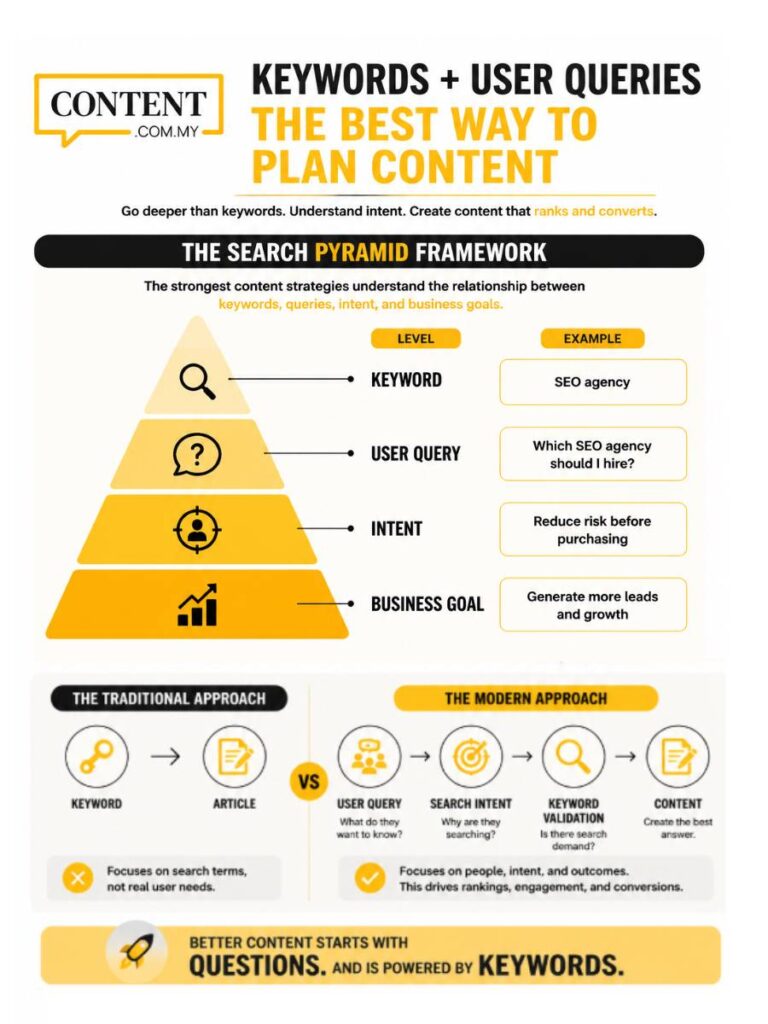
The traditional approach often looks like this: Keyword → Article
The modern approach looks more like:
User Query → Search Intent → Keyword Validation → Content
The Search Pyramid Framework
5. Use AI Without Sacrificing Quality
The rise of AI tools has changed how content is created and with it came the flood of AI slop. Poblems arise when businesses mistake AI output for finished content. Our advice?
Don’t let AI take the wheel, keep your hand firmly on the steering.
AI can generate information quickly but it cannot independently verify facts, understand organisational priorities, or provide genuine expertise.
Good AI Use | Poor AI Use |
Outline creation | Publishing without review |
Topic ideation | Copying entire outputs |
FAQ generation | Skipping fact-checking |
Research assistance | Fabricating statistics |
Content repurposing | Ignoring brand voice |
Workflow support | Replacing human judgement |
AI should handle repetitive tasks and accelerate workflows while humans remain responsible for strategy, quality control, and decision-making.
In fact, to prevent AI slop or Google penalizing lazy content, read our 10 signs Your Content is AI-generated and How to avoid it.
Trust on this, at the very least hide your AI tracks yeah?
Should You Build, Borrow, Or Buy Content Expertise?
Not every business needs to solve content challenges in the same way. Some organisations already have capable writers and simply need better systems.
Others require specialist expertise that may not exist internally like writing for a new industry.
One useful tip is to think in terms of building, borrowing, or buying capability.
Approach | What It Means | Best For |
Build | Train existing team members | Long-term capability development |
Borrow | Work with agencies or consultants | Specialist support and scalability |
Buy | Hire experienced talent | Immediate expertise and leadership |
For growing businesses, we suggest a hybrid model.
- Internal teams provide industry knowledge, customer insights, and brand understanding.
- External specialists contribute SEO expertise, content strategy, editorial support, or additional production capacity.
This approach allows businesses to improve content quality without overextending internal resources and it allows breathing room.
Upskilling Your In-House Content Writing Team To Improve Long-Term Growth
As market trends change and the skill floor for writers increases, upskilling is the best way to get better business outcomes.
Investing in your employees or people is more than a “feel good” moment too. Businesses often see improvements in:
- Organic traffic growth
- Search visibility
- AI search visibility
- Content consistency
- Lead generation
- Marketing efficiency
- Content ROI
At Content.com.my, we regularly work with businesses that already have internal marketing teams but need additional support with SEO content, editorial processes, content strategy, or production capacity.
If you need advice or a second-opinion, why not drop us a message!

Frequently Asked Questions About Keywords vs User Queries
Are Keywords Still Important For SEO?
Yes. Keywords remain essential for understanding search demand and topic relevance. However, they should be combined with user intent and audience research.
What Is The Difference Between A Keyword And A User Query?
A keyword is the search term entered into a search engine. A user query represents the underlying question, need, or goal behind that search.
Should Content Planning Start With Keyword Research?
Not necessarily. Many successful content strategies begin by identifying audience questions and then validating those topics through keyword research.
How Do I Find User Queries For Content Ideas?
Review customer emails, sales conversations, support tickets, reviews, FAQs, and People Also Ask results. These often reveal valuable content opportunities.
Why Are User Queries Becoming More Important?
Search engines and AI-powered search tools increasingly focus on understanding intent and delivering direct answers rather than matching exact keywords.
Can One Keyword Support Multiple Articles?
Absolutely. A single keyword often represents multiple questions, concerns, and decision stages, making it suitable for an entire topic cluster rather than one standalone article.