
Key Takeaway
- Strong content teams require SEO, AI, research, and editorial skills, not just writing ability.
- Most content performance problems stem from systems and processes rather than talent.
- AI can improve productivity, but human oversight remains necessary for quality and strategy.
- Content training should focus on projects, not just courses and certifications.
- Businesses often achieve better results through a hybrid model of internal and external expertise.
Table of Contents
Upskilling an in-house content writing team requires more than improving writing skills. Businesses need to develop SEO knowledge, research capabilities, AI workflows, editorial standards, and performance measurement processes to create content that ranks, attracts traffic, and generates enquiries.
As a content marketing agency, we know how difficult it is to upskill your content writing team, especially if the person is a newbie. Consider the following scenario present in many organizations:
- Articles are published consistently
- The website starts filling up with blog posts.
- Six months later, traffic remains stagnant.
- Leads are limited.
- Management begins questioning whether content marketing actually works.
Between Google’s AI Overviews, ChatGPT Search, Gemini, and increasingly competitive search results, content teams are expected to do far more than write well.
But where do you start? Let’s talk about it.
What Skills Should A Modern Content Writing Team Develop?
Modern content teams need a combination of writing, SEO, research, AI, and commercial awareness.
A decade ago, content writing was largely viewed as a communication skill.
Today, content writers sit much closer to the intersection of marketing, sales, customer education, and search visibility.
The expectations have expanded significantly.
Skill | Why It Matters | Business Impact |
Writing | Improves clarity and readability | Better engagement |
SEO | Improves discoverability | More organic traffic |
Research | Improves accuracy and trust | Stronger credibility |
AEO | Improves AI search visibility | More citations and exposure |
AI Workflows | Improves efficiency | Faster production |
Conversion Writing | Supports business goals | More enquiries and leads |
We have been advocating for this as well, basic on-page SEO skill is needed for many content teams now.
Why Do Many Content Teams Produce Content Without Producing Results?
The problem is often the system, not the writer.
Before we talk about how to improve your team, let’s talk about what’s really going on the ground.
We can speak from experience, whenever we work with clients that have their own in-house SEO team, they usually follow a typical pattern.
- A marketing executive or writer is tasked with publishing four blog articles every month.
- They receive a topic and conduct basic research
- They wrote the article and published it
- Theeeeen nothing happens
There is nobody to track rankings, performance or conversions. The writer or person in charge just moves on to the next article and the cycle repeats itself.
The’s also common issues such as:
- Weak content briefs
- No documented process
- Poor search intent research
- Limited editorial review
- No content performance tracking
- Lack of ongoing optimisation
This is more prevalent for SMEs because unlike larger organisations with dedicated content departments, small businesses often rely on a single marketing executive to manage everything from social media creation and content writing.
Content Production Vs Content Performance
Content Production | Content Performance |
More articles | Better results |
More words | Better visibility |
More writers | Better systems |
More publishing | Better optimisation |
More AI usage | Better judgement |
More activity | Better outcomes |
This shift in thinking is often the first step towards improving content performance.
Once you get the gist of it, we can talk about improving your team.
1. Identify Skill Gaps In Your Content Team
Before investing in training, businesses need to identify where their content team is actually struggling.
Don’t slap on a Coursera course on your writers right away, let’s take a breather first.
- A writer can be grammatically excellent while still lacking SEO knowledge, research skills, or strategic thinking.
- Conversely, a writer may not be eloquent in their writing but they know the SEO structure.
One of the simplest approaches is conducting a content team audit. The editor or manager can review several recently published articles and assess the following areas.
Content Team Audit
Question | Yes | No |
Can writers identify search intent? | ||
Can they create SEO-friendly outlines? | ||
Can they evaluate source credibility? | ||
Can they optimise internal links? | ||
Can they write FAQ sections effectively? | ||
Can they structure content for AI search? | ||
Can they interpret performance data? |
Training becomes significantly more effective when businesses identify the root cause instead of applying generic solutions.
Better yet, have one audit form for each writer to evaluate their strengths and weaknesses.
2. Know What High-Performing Content Look Like
High-performing content teams operate differently from content production teams.
One useful way to assess maturity is by comparing how content is created inside the organisation.
The differences are often more operational than creative, so management take notes!
Capability | Beginner Team | Mature Team |
Brief Creation | Topic only | Search intent, audience, goals |
Research | Basic Google search | Multiple authoritative sources |
SEO | Keywords only | Intent, entities, internal linking |
AI Usage | Draft generation | Workflow acceleration |
Measurement | Published articles | Traffic, rankings, leads |
Optimisation | Publish and forget | Continuous improvement |
Notice that none of these differences relate directly to writing talent, they relate to operational systems.
The strongest content teams build repeatable processes that allow good writers to consistently produce high-performing content without editors spending extra time fixing them.
That is ultimately the goal of upskilling and automation.
3. Improve Research Quality For Writers
Research quality often determines the difference between average content and authoritative content.
If you simply repeat information from other websites, then you are not standing out. Strong content teams develop research habits that improve content credibility and usefulness.
Use the below sources for research depending on content type.
Source Type | Examples |
Government Data | DOSM, Bank Negara Malaysia |
Tax Information | LHDN |
SME Insights | SME Corp Malaysia |
Digital Economy Data | MDEC |
Industry Reports | Market and industry studies |
Internal Experts | Sales teams, consultants, account managers |
Even citing research or statistics and attributing them to government sites boost the credibility of your writing.
Another commonly overlooked source is internal expertise.
- Sales teams
- Customer service teams
- Consultants
- Account managers
These folks often hear customer questions every day, and those questions become some of the most valuable content topics a business can create.
Instead of relying entirely on keyword tools, content teams should regularly collaborate with subject matter experts inside the organisation and produce content customers actually want to know.
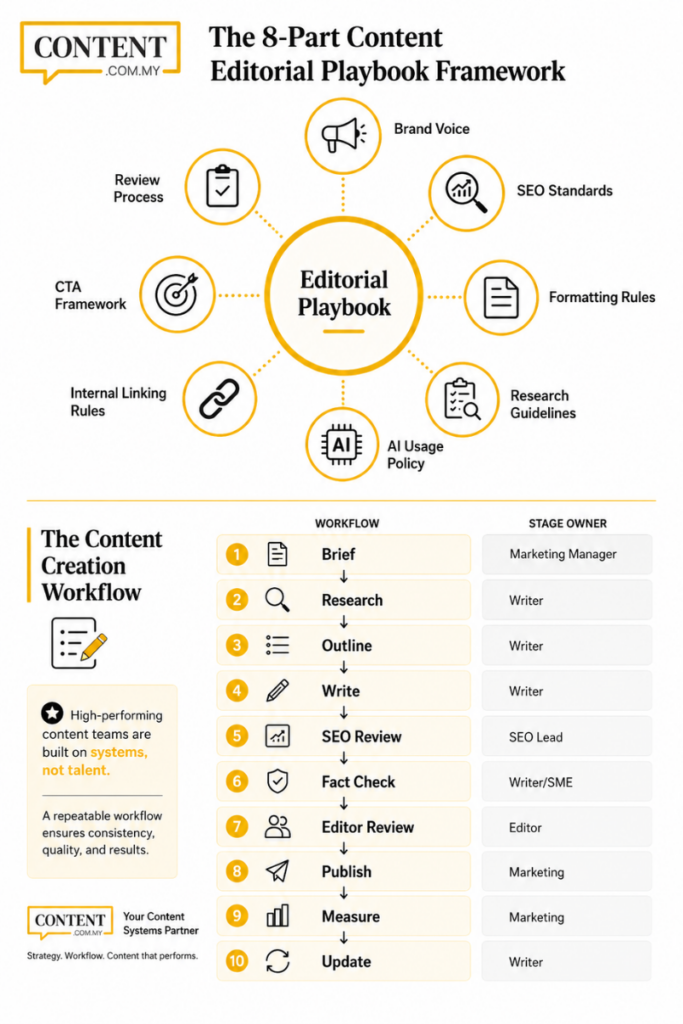
4. Get An Editorial Playbook
Consistency becomes difficult to maintain without documented standards. As businesses grow, content creation becomes increasingly complex.
- New writers join the team.
- Different contributors develop different writing habits.
- Content quality becomes inconsistent.
An editorial playbook helps solve this problem, having a baseline or a framework you must adhere to helps with consistency.
A strong editorial playbook may include:
- Brand voice guidelines
- Formatting standards
- SEO requirements
- Source verification processes
- Internal linking guidelines
- AI usage policies
- CTA frameworks
- Content review procedures
Without these standards, every piece of content starts from scratch and the writers don’t know where to start
With them, content creation becomes more efficient and predictable.
5. Use AI Without Sacrificing Quality
The rise of AI tools has changed how content is created and with it came the flood of AI slop. Poblems arise when businesses mistake AI output for finished content. Our advice?
Don’t let AI take the wheel, keep your hand firmly on the steering.
AI can generate information quickly but it cannot independently verify facts, understand organisational priorities, or provide genuine expertise.
Good AI Use | Poor AI Use |
Outline creation | Publishing without review |
Topic ideation | Copying entire outputs |
FAQ generation | Skipping fact-checking |
Research assistance | Fabricating statistics |
Content repurposing | Ignoring brand voice |
Workflow support | Replacing human judgement |
AI should handle repetitive tasks and accelerate workflows while humans remain responsible for strategy, quality control, and decision-making.
In fact, to prevent AI slop or Google penalizing lazy content, read our 10 signs Your Content is AI-generated and How to avoid it.
Trust on this, at the very least hide your AI tracks yeah?
Should You Build, Borrow, Or Buy Content Expertise?
Not every business needs to solve content challenges in the same way. Some organisations already have capable writers and simply need better systems.
Others require specialist expertise that may not exist internally like writing for a new industry.
One useful tip is to think in terms of building, borrowing, or buying capability.
Approach | What It Means | Best For |
Build | Train existing team members | Long-term capability development |
Borrow | Work with agencies or consultants | Specialist support and scalability |
Buy | Hire experienced talent | Immediate expertise and leadership |
For growing businesses, we suggest a hybrid model.
- Internal teams provide industry knowledge, customer insights, and brand understanding.
- External specialists contribute SEO expertise, content strategy, editorial support, or additional production capacity.
This approach allows businesses to improve content quality without overextending internal resources and it allows breathing room.
Upskilling Your In-House Content Writing Team To Improve Long-Term Growth
As market trends change and the skill floor for writers increases, upskilling is the best way to get better business outcomes.
Investing in your employees or people is more than a “feel good” moment too. Businesses often see improvements in:
- Organic traffic growth
- Search visibility
- AI search visibility
- Content consistency
- Lead generation
- Marketing efficiency
- Content ROI
At Content.com.my, we regularly work with businesses that already have internal marketing teams but need additional support with SEO content, editorial processes, content strategy, or production capacity.
If you need advice or a second-opinion, why not drop us a message!

Frequently Asked Questions About Upskilling In-house Content Writing Team
How Do I Upskill My In-House Content Writing Team In Malaysia?
Start by identifying skill gaps in SEO, research, AI usage, and content strategy. Training should combine real projects, feedback, and structured learning rather than relying solely on courses.
What Skills Should A Content Writer Learn Today?
Modern content writers should understand SEO, AEO, research methods, AI tools, content strategy, and conversion-focused writing in addition to strong writing fundamentals.
Is SEO Training Important For Content Writers?
Yes. Writers who understand search intent, keyword targeting, internal linking, and content optimisation are better equipped to create content that attracts organic traffic.
Can AI Help An In-House Content Team Write Better?
AI can improve efficiency through research support, outlining, and content repurposing. Human oversight remains necessary for strategy, fact-checking, and quality control.
Should I Outsource Content If I Already Have An In-House Team?
Not necessarily. Many businesses use a hybrid approach where internal teams provide subject matter expertise while external specialists support SEO, strategy, and scalability.
How Do I Measure Content Team Improvement?
Track metrics such as organic traffic, keyword rankings, AI visibility, content engagement, lead generation, publishing consistency, and content update performance.