
Key Takeaway
- Academic writing is a scoring skill that helps students turn knowledge into marks.
- Examiners reward clear arguments, evidence, and analysis more than complex vocabulary.
- The PEEL framework can improve paragraph quality in essays, reports, and exams.
- Strong academic writing focuses on answering the question, not simply displaying knowledge.
- Small improvements in structure and critical thinking can lead to significant grade improvements.
Table of Contents
Academic writing helps students communicate ideas clearly, support arguments with evidence, and answer exam questions effectively. Students who master academic writing often score higher because examiners can easily understand their reasoning, evaluate their knowledge, and award marks accordingly.
Academic writing is one of the biggest differences between average-performing students and top-performing students. The difference between you scoring an A or you getting a B+.
Sounds stressful right? But here’s the thing, you don’t need to master the language to score well, it’s a skill that can be learned.
Today, we will explain what academic writing is, why students commonly lose marks, and the framework that can help students improve their essays and assignments.
How Does Academic Writing Differ From Everyday Writing?
Academic writing focuses on evidence, reasoning, and analysis rather than personal opinion alone.
Most people use casual writing every day through text messages, social media posts and conversations. Academic writing serves a different purpose.
Instead of simply sharing thoughts, academic writing requires students to explain ideas, support arguments, and demonstrate understanding.
Consider the difference below.
Casual Writing | Academic Writing |
Personal opinion | Evidence-based argument |
Informal language | Formal language |
General statements | Specific examples |
Describes ideas | Analyses ideas |
Flexible structure | Clear structure |
In other words, justify your points and explain why they are valid or correct. For example:
Casual: Social media is bad for students.
Academic: Social media is bad for students because using too much of it will reduce study time and increase distractions.
The second example explains why the statement may be true rather than simply making a claim. That distinction often separates higher-scoring answers from lower-scoring ones.
Why Do Malaysian Students Struggle With Academic Writing?
We believe students know the content but struggle to communicate it in the way examiners expect.
Language Difficulty
For students who primarily speak Bahasa Malaysia, Mandarin, Tamil, or other languages at home, writing complex ideas in English can feel difficult.
Memorisation-focused study habits
A lot of students become very good at remembering information, we bet you know all of the Nilai Murnis and their meaning.
This works well for factual questions but becomes less effective when examiners ask students to justify their answers.
Focusing On The Wrong Things
Many students believe higher grades come from:
- Bigger vocabulary (Big flowery words like inconsequential or bombastic)
- Longer essays to meet the word count
- More difficult words
- Longer sentences
But really, examiners usually prioritise:
- Relevance
- Clarity
- Evidence
- Analysis
- Logical reasoning
A simple answer that directly answers the question often scores higher than a complicated answer that misses the point.
“Examiners appreciate it if you can convey a point in a few sentences backed by evidence!”
Common Student Scenarios in Academic Writing
Let’s look at a few situations that happen more often than most students realise. If either scenario describes you, take notes!
Scenario 1: The Student Who Memorised Everything
A student spends an entire week memorising five pages of notes about climate change.
The exam question asks:
Evaluate the effectiveness of government policies in reducing carbon emissions.
Instead of evaluating the policies, the student writes everything they know about climate change
- Greenhouse gases
- Rising temperatures
- Melting ice caps
- Deforestation
- Hotter weather
The answer contains plenty of information and it’s very impressive! Unfortunately, much of it does not answer the actual question.
The examiner was looking for an evaluation of government policies, not a summary of climate change.
Scenario 2: The Student Who Wrote Too Much
A university student is asked:
Explain two advantages of remote working
The student writes three pages covering:
- Productivity
- Technology adoption
- Work-life balance
- Transportation costs
- Company profits
- Globalisation.
The answer is long and detailed, but it also wanders far beyond the scope of the question.
Meanwhile, another student gives two well-explained advantages with supporting examples and scores higher despite writing less.
Scenario 3: The Student Who Knew The Answer
A lecturer asks:
Analyse the impact of social media on academic performance.
The student writes:
Social media is popular among students. Many students use Instagram, TikTok, Facebook, and X. Social media is growing every year.
Everything written is technically correct but none of the writing actually analysed the impact on academic performance.
The answer describes social media rather than examining its effects.
Scenario 4: The Student Who Tried To Sound Smart
A student believes academic writing means using the biggest words possible, this is one of the most common mistakes we see.
Instead of writing:
Online learning can improve flexibility for students.
They write:
The multifaceted implementation of technologically facilitated pedagogical methodologies significantly enhances educational accessibility paradigms.
The sentence sounds impressive, but it is also hard to understand. Big words DOES NOT mean good scores, and frankly even we don’t know what that really means.
Examiners reward clarity more than complexity, making it simple and easy to understand.
Scenario 5: The Student Who Forgot To Explain
A student writes:
According to a survey, 75% of students use online learning platforms.
Then they move on to the next point. The examiner reads the statistic and thinks: Okay… and why does that matter?
The student provided evidence but forgot to explain its significance.
This is one of the most common reasons students receive feedback such as:
- Expand your explanation
- Needs more analysis
- Weak discussion
- Elaborate further
In many cases, students are not losing marks because they lack knowledge but you didn’t present that knowledge in a way that examiners can easily assess.
Why Is Academic Writing More About Marks Than English?
Academic writing is ultimately a scoring system that helps examiners assess understanding.
Examiners need to mark hundreds of papers within a short period. The easier it is to identify your understanding, the easier it becomes to award marks.
What Examiners Are Actually Looking For
Element | Why It Matters |
Understanding the question | Prevents off-topic answers |
Clear structure | Makes answers easier to follow |
Evidence | Demonstrates knowledge |
Explanation | Shows understanding |
Analysis | Shows deeper thinking |
Relevance | Keeps the answer focused |
Notice that advanced vocabulary is NOT at the top of the list. Many students spend years trying to sound smarter when they should focus on becoming clearer.
The A-Grade Academic Writing Formula
Strong academic writing follows a simple pattern:
- Answer the question
- Support your argument
- Explain why it matters
This is the TLDR of academic writing and it’s very effective.
Question Understanding → Argument → Evidence → Analysis → Marks
Step 1: Understand The Question
Before writing anything, always identify what the examiner is asking.
Look for command words such as:
- Explain
- Analyse
- Compare
- Evaluate
- Discuss
- Justify
Each command word requires a different type of response.
For example:
Command Word | What The Examiner Wants | Example |
Explain | Reasons and causes | Why did inflation increase? |
Compare | Similarities and differences | Compare online learning and traditional learning. |
Analyse | Breakdown and interpretation | Analyse the factors affecting employee productivity. |
Evaluate | Strengths, weaknesses, and judgement | Evaluate the effectiveness of government subsidies. |
Discuss | Multiple perspectives | Discuss the impact of artificial intelligence on jobs. |
Justify | Defend a position using evidence and reasoning | Justify the use of renewable energy as a long-term solution. |
Students often lose marks because they answer a different question from the one being asked.
Step 2: Build A Clear Argument
Every answer should have a central idea. Instead of listing facts, decide what point you are trying to make.
For example:
Weak approach:
Renewable energy is important. Solar energy exists. Wind energy exists. Hydroelectric energy exists.
Strong approach:
Renewable energy is becoming increasingly important because it reduces dependence on fossil fuels and supports long-term environmental sustainability.
The second example gives the answer direction and purpose.
Step 3: Support Your Points With Evidence
This is by one of the most important points in academic writing, evidence can come from:
- Statistics
- Research studies
- Case studies
- Historical examples
- Academic theories
- Textual references
Evidence shows the examiner that your argument is based on knowledge rather than opinion. If you’re writing an academic paper with citations, this is a must.
Step 4: Analyse The Evidence
A common scenario is students provide the evidence but never explain it.
Weak:
A study found that students spend four hours daily on social media.
Strong:
A study found that students spend four hours daily on social media. This suggests that excessive screen time may reduce study hours and concentration, which could negatively affect academic performance.
The explanation is often where higher marks are earned.
Step 5: Link Back To The Question
Every paragraph should contribute toward answering the original question.
If a paragraph does not help answer the question, it probably does not belong in the answer.
Read more: Guide to Technical Report Writing: Best Practices and Tips
How Can Students Write Stronger Introductions?
A strong introduction tells the examiner what the answer is about and where the discussion is heading.
Students either write introductions that are too short or spend half a page repeating the question. Neither approach adds much value.
A good introduction should:
- Introduce the topic
- Provide context
- Present the main argument
- Set expectations for the discussion
Academic Introduction Template
The issue of [topic] has become increasingly important because [reason]. While different perspectives exist regarding [topic], this essay will examine [main focus] and argue that [main position].
Example
Question:
Discuss the impact of social media on student learning.
Introduction:
The impact of social media on student learning has become an increasingly important topic because of widespread use of digital platforms. While social media provides educational opportunities, it can also create distractions that affect academic performance. This essay will examine both the benefits and negatives of social media and argue that its impact depends largely on how it is used.
Notice that the introduction does not try to explain everything. Its job is simply to guide the reader and tell them what the rest of the article is about.
In fact, look at the introduction of this article itself! See if you can spot any similarities.
Use The PEEL Method to Improve Academic Writing
The PEEL framework helps students write focused paragraphs that are easier to understand and easier to award marks to.
One of the biggest problems in academic writing is the “wall of text” paragraph.
Students often put multiple ideas into one paragraph, making it difficult for examiners to identify their main point.
PEEL solves that!
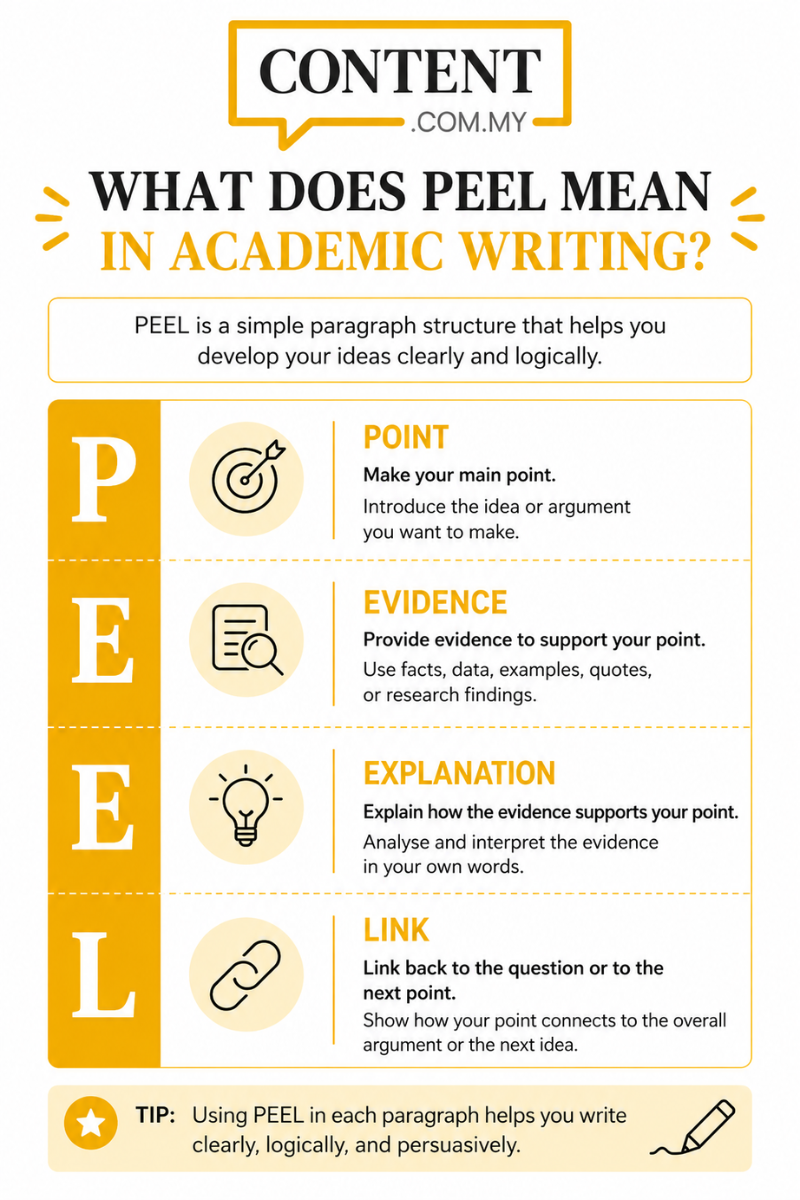
Example Of A PEEL Paragraph
- Point
Social media can negatively affect academic performance.
- Evidence
A study found that students who spend significant amounts of time on social media often report lower academic results.
- Explanation
This may occur because excessive social media usage reduces study time and increases distractions during revision.
- Link
Therefore, uncontrolled social media use may contribute to weaker academic performance among students.
Why PEEL Works: PEEL forces students to do something many forget, which is to explain their evidence.
How Can Students Use Evidence More Effectively?
Evidence earns marks when it supports an argument, not when it is simply inserted into an answer.
A common mistake is what lecturers often call “evidence dumping”, this happens when students present facts without discussing them.
Weak Example
A survey found that 70% of students use online learning platforms.
The examiner now knows a statistic but they still do not know why it matters.
Strong Example
A survey found that 70% of students use online learning platforms. This suggests that digital learning has become a major part of modern education, allowing students greater flexibility when accessing learning materials.
The statistic now supports an argument.
Sources Of Evidence Students Can Use
- Research studies
- Statistics
- Historical examples
- Government reports
- Academic theories
- Textual references
- Real-world case studies
The quality of evidence matters, but the explanation matters just as much.
What Does Critical Thinking Look Like In Academic Writing?
Critical thinking means evaluating ideas rather than simply describing them.
In Malaysia, KBAT or HOTS questions often require students to answer in critical thinking.
In simple terms, you need to discuss:
- Why it matters
- Its strengths
- Its weaknesses
- Other viewpoints
- Potential downsides of your point
Example
Descriptive: Online learning is convenient.
Critical: Online learning improves accessibility for students, but its effectiveness depends on internet access, student motivation, and course design.
The second statement demonstrates analysis and that is exactly what many examiners are looking for.
A Simple Critical Thinking Formula
Whenever you make a point, ask:
- Why?
- So what?
- Compared to what?
- Under what conditions?
These questions naturally lead to stronger analysis.
Which Academic Writing Mistakes Cost The Most Marks?
The good news is that these mistakes can usually be fixed quickly once identified.
Mistake | Why It Hurts Marks | Severity Of Marks Lost |
Not answering the question | Leads to irrelevant content | Very High |
No analysis | Limits higher-level marks | Very High |
Lack of evidence | Weakens credibility and support | High |
Unsupported opinions | Weak academic argument | High |
Weak paragraph structure | Makes arguments difficult to follow | Medium-High |
Poor conclusions | Leaves arguments incomplete | Medium |
Repetition | Wastes word count and adds little value | Medium |
Overly long sentences | Reduces clarity and readability | Low-Medium |
How Can Students Improve Academic Writing Before Exams?
- Practise one PEEL paragraph each day
- Review past-year exam questions
- Rewrite weak answers after receiving feedback from teachers
- Read high-scoring sample essays (Best way!)
- Build a collection of useful examples and case studies
- Learn common command words used in exams
When Should Students Seek Academic Writing Support?
Sometimes students need guidance to identify weaknesses that they cannot see themselves and that’s okay.
Students can continue making the same mistakes because nobody has explained what is going wrong.
You may benefit from additional support if:
- Your grades remain inconsistent
- Feedback repeatedly mentions weak analysis
- You struggle to organise ideas
- You find essay writing stressful
- You are preparing for major examinations like SPM, STPM or university assignments
Remember: Support does not have to mean someone writing for you, it just means feedback that shows you how to improve your own work.
Conclusion:Better Academic Writing Can Improve Exam Results
Academic writing is often misunderstood as a language skill but really, it is a communication skill.
The purpose of academic writing is to help examiners see what you know and how well you understand a topic, your job as a student is to deliver that information to them as clearly as possible.
If there is one lesson to take away from this guide, it is this:
“Knowledge alone does not earn marks, knowledge that is communicated clearly does.”
These skills will help you far beyond the classroom, from university presentations to even your career! So write clearly, answer the question and make sure to explain your points.
This guide on academic writing was brought to you by content.com.my, the leading content marketing agency in Malaysia dedicated to helping Malaysians write better content.

Frequently Asked Questions About Academic Writing in Malaysia
What Is Academic Writing?
Academic writing is a formal style of writing used in schools, colleges, and universities. It focuses on evidence, analysis, and clear communication rather than personal opinions alone.
Why Is Academic Writing Important For Exams?
Academic writing helps students present their knowledge clearly. Strong academic writing makes it easier for examiners to understand arguments and award marks.
How Can I Improve My Academic Writing Quickly?
Focus on answering the question, using evidence, applying the PEEL framework, and practising structured paragraphs regularly. Small improvements can have a noticeable impact on grades.
Is Academic Writing Only About Grammar?
No. Grammar matters, but examiners also assess understanding, evidence, analysis, relevance, and argument quality. Strong ideas often matter more than perfect grammar.
What Is The PEEL Method In Academic Writing?
PEEL stands for Point, Evidence, Explanation, and Link. It helps students create focused paragraphs that support arguments clearly and logically.
Can Templates Help With Academic Writing?
Yes, templates can help students organise their ideas. However, they should be used as guides rather than copied directly into assignments or exams.