
Key Takeaway
- There is no universal content update schedule that applies to every website.
- High-change industries such as SEO, AI, tax, finance, and regulations often require more frequent updates.
- Traffic declines, ranking losses, and outdated information are strong indicators that content needs attention.
- Not every page should be refreshed. Some pages may need rewriting, consolidation, or removal.
- A content audit helps businesses prioritise updates based on impact rather than guesswork.
Table of Contents
In 2024, you published a blog that performed surprisingly well. It ranked on Google, generated clicks, and brought in steady traffic. Happy with the results, you moved on to the next marketing content.
Fast forward to 2026, you revisit that same article for spring clinging and realise: “Wah, half the information is outdated already.”
- The screenshots are old.
- The statistics are no longer current.
- Some industry practices have changed.
Meanwhile, competitors have published fresher, more comprehensive content. Naturally, this begs the question:
How often should you update your content?
The short answer: it depends.
The long answer: it really depends.
Why Updating Content Matters
Search engines like Google want to provide users with the best possible answer. If newer, more relevant content exists elsewhere, older articles gradually lose visibility because search engines will always prioritize fresh and relevant content.
This process is often referred to as content decay.
Content decay can happen for several reasons:
Cause | Example |
Information becomes outdated | Tax rates, regulations, software interfaces |
Search intent evolves | Users expect more detailed answers than before |
Competitors publish better content | New guides provide deeper insights |
User behaviour changes | New trends influence search patterns |
Internal linking becomes weaker | Older content receives less support from newer pages |
The result is often a gradual decline in rankings, impressions, clicks, and conversions.
Why Fixed Content Update Schedules Often Fail
The next question businesses will ask is how often content should be updated? Every three, six, or twelve months?
This is where we like to emphasize our tittle, it depends.
Imagine two articles from an accounting firm:
- “Malaysia e-Invoicing Requirements for Businesses”
- “What Is a Balance Sheet?”
The first topic is heavily influenced by regulatory updates and government announcements.
The second covers a fundamental accounting concept that changes very little over time.
Applying the same update schedule to both articles makes little sense because if it ain’t broke, don’t fix it.
Instead of relying on arbitrary timelines, businesses should evaluate content based on a case on case basis.
What Signals Indicate Content Needs Updating?
Usually, when a competitor’s blog does better than yours (by ranking higher), then that is your sign. But let’s go in depth.
Organic Traffic Is Declining
If an article consistently loses traffic over several months, it means:
- Competitors have published stronger content
- Search intent has shied/trend over
- AI overview had taken your clicks
A temporary fluctuation is normal, but a long-term downward trend deserves investigation.
Rankings Are Gradually Falling
Sometimes traffic remains stable even when rankings start slipping.
Monitoring keyword positions can help identify potential issues before traffic losses become significant.
For example:
Ranking Change | Recommended Action |
Position 3 to 5 | Monitor |
Position 3 to 8 | Refresh content |
Position 3 to Page 2 | Major update required |
Information Is No Longer Accurate
This is one of the most obvious signals and probably the most common factor.
Common examples include:
- Regulatory changes
- Pricing changes
- Product updates
- New technology developments
- Updated industry standards
Outdated information can damage trust and reduce content quality. One tell-tale sign is if your blog has a year in it, such as “How to choose the best AI tools in 2026”, you should update it when 2027 hits.
Click-Through Rates Are Falling
If impressions remain strong but clicks decline, the issue may not be the content itself.
Instead, the title tag and meta description may no longer be competitive. Now, that doesn’t mean you should slap on clickbait titles, but at the very least make it more exciting.
Use the formula of [Action Verb] + [Problem] + [Year/Target]
Refreshing these elements can sometimes improve performance without rewriting the entire article.
Which Types of Content Need Frequent Updates?
Not all content ages at the same speed. If you’re serious on updating your blogs, we recommend you to categorise content according to volatility.
High-Volatility Content
These topics change rapidly and often require regular monitoring.
Examples include:
- SEO
- Artificial intelligence
- Digital marketing
- Tax regulations
- Employment laws
- Financial compliance
Review cycle: Every 1 to 3 months.
Medium-Volatility Content
These subjects evolve more gradually but do pay attention to policy changes especially from governments.
Examples include:
- HR best practices
- Business operations
- Leadership
- Sales processes
- Industry trends
Review cycle: Every 6 to 12 months.
Low-Volatility Content
These topics remain relatively stable over time. What-is and how-tos blog tend to not need much update unless the status quo has been affected.
Examples include:
- Historical content
- Foundational concepts
- Educational guides
- Definitions
Review cycle: Annual review or performance-triggered updates.
Should You Refresh, Rewrite, Consolidate, or Remove?
It depends.
Updating content does not always mean editing a few paragraphs, changing the title and calling it a day. But it also doesn’t mean a FULL rewrite either.
Different situations require different actions.
Situation | Recommended Action |
Information remains accurate | Refresh |
Search intent has changed | Rewrite |
Multiple weak articles cover similar topics | Consolidate |
Content no longer serves a purpose | Remove or redirect |
This prevents businesses from wasting resources on low-value updates, which brings us to our next point.
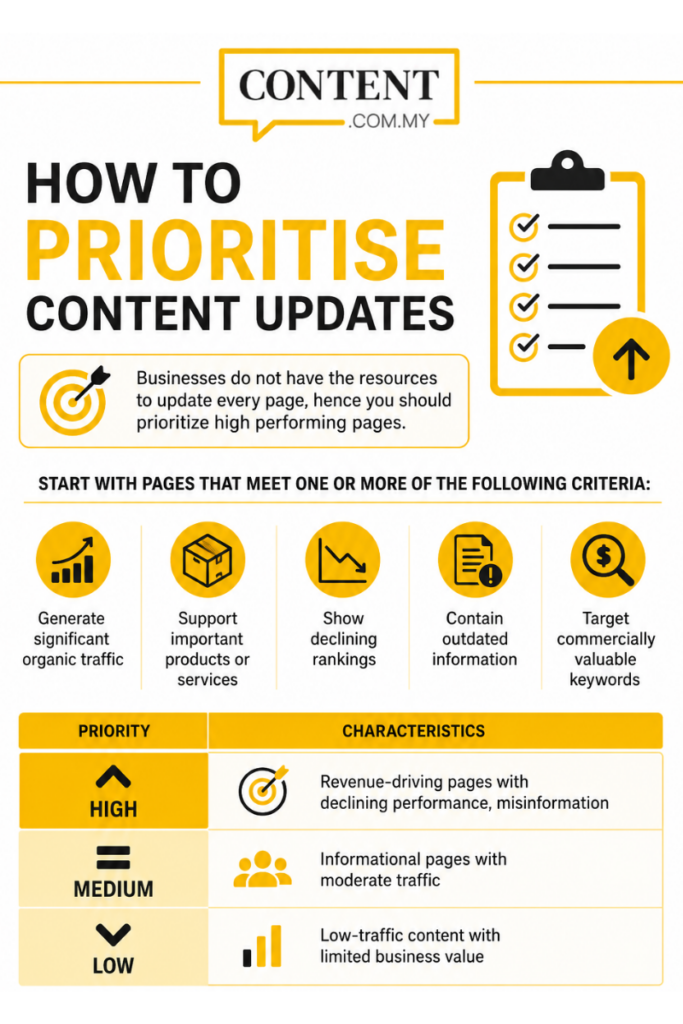
Outdated information can really affect how search engines view your content, hence if you spot any article or content that has it, this should go to the priority as well.
How Often Should You Conduct a Content Audit?
It depends, a content audit helps answer questions such as:
- Which pages are losing traffic?
- Which articles contain outdated information?
- Which topics have become duplicated?
- Which pages continue generating results?
As a general guideline:
Website Size | Suggested Audit Frequency |
Small websites | Every 6 to 12 months |
Medium websites | Every 3 to 6 months |
Large content sites | Quarterly or ongoing |
If you have a dedicated content team, then a higher frequency is okay just strike a balance, changing every content monthly is not needed.
Instead of asking “Has this article reached six months old? Ask:
- Is it still accurate?
- Is it still ranking?
- Is it still generating business value?
- Does it still match what users are searching for?
Once you’re able to map it out, you have a clear view of your content scheduling.
Update Your Content Depending On Your Needs
While it can be a pain, businesses that monitor content health regularly often achieve better long-term results than those that focus solely on publishing new articles.
But if managing content updates across dozens or hundreds of pages feels overwhelming, a proper content audit can help identify the highest-impact opportunities first.
At Content.com.my, we help businesses with their content management strategy. We know AI is useful with churning out ideas, scheduling and topics, but can it monitor your GSC, rankings and provide custom solutions?
Probably not, at least not yet. And that’s our value proposition to you. If you feel your content is outdated or needs a third-party consultation, our content marketing agency is here to help.

Frequently Asked Questions About Why Content Team Silos
What does it mean when a content team works in silos?
It means writers, designers, SEO specialists, social media teams, and managers work with separate information. Each person may know part of the update, but nobody has the full picture.
Why does my content team keep making the same mistakes?
Repeated mistakes often happen because the source information is unclear, outdated, or scattered. If the brief, feedback, and final updates are not centralised, the same errors can keep returning.
How can businesses improve content team communication?
Start by creating one source of truth, improving briefs, assigning clear owners, and setting review rules before work begins. Tools help, but the process matters more.
Do writers need to know sales and customer feedback?
Yes. Sales and customer feedback help writers understand real questions, objections, and buying concerns. This makes content more useful, specific, and relevant to the reader.
Are WhatsApp groups enough for managing content updates?
WhatsApp is useful for quick communication, but it is weak for final approvals and version control. Important updates should be moved into a shared document, brief, or project board.
How does messy internal communication affect content?
Content becomes generic when keyword research is not supported by business insight. Writers need search intent, customer questions, service details, and proof points to create stronger content.