
Key Takeaway
- Content teams need context before they can create useful, accurate, and timely work.
- Scattered updates across WhatsApp, email, calls, and folders often lead to avoidable mistakes.
- Writers, designers, SEO specialists, and social media teams need one shared source of truth.
- Weak briefs usually create weak content, even when the team itself is capable.
- Better content starts with clearer internal updates, ownership, review flow, and documentation.
Table of Contents
When a content team has no idea what’s going on, well then that is a communication issue. Content needs context. Without it, even a good writer can write the wrong thing.
And if you have ever worked in a marketing team, agency, or growing business, you probably know the scene.
“Eh, where is the final client feedback for the Raya campaign?”
“Check the WhatsApp group.”
“Which one? There are four different groups for this client.”
“No, wait. I think the client emailed it to the account manager, but she is on MC today.”
By the time the team finds the latest update, someone has already drafted a copy using the old promotion, the designer has created visuals with the wrong date, and the social media caption is waiting for approval from someone who has not seen the newest version.
Familiar? This is what happens when a content team works on information silos and as a content marketing agency, we had to learn it the hard way so let’s impart our knowledge to you.
Why Does Content Go Wrong Even When Everyone Is Working Hard?
Content goes wrong when proper information is not communicated. This happens when everyone is doing their own thing but no one sharing the information to the other department.
What Happens | What It Looks Like | What Usually Caused It |
Wrong promotion mentioned | Old discount appears in a caption | Latest update was only shared in chat |
Slow content approval | Draft keeps getting returned | No clear decision-maker |
Generic blog content | Article sounds vague | Writer did not get sales or customer insight |
Conflicting messaging | Website says one thing, social says another | No shared content reference |
Team burnout | People keep redoing work | Feedback and updates are scattered |
The painful part is that these mistakes look like “content quality issues” from the outside.
But inside the team, it’s a lack of communication.
Why Is Context So Important in Content Creation?
Content is context dependent and while we sound like a broken record right now, let’s illustrate how important this is.
Let’s say a writer is writing a marketing content page for a client. He or she needs to know:
- Is there a new promotion?
- Has the pricing changed?
- Is one service now the priority?
- Are customers asking new questions?
- Is there a claim the company wants to avoid?
- Is there a product or service no longer available?
- Did the client approve the final angle?
- Has management changed the offer?
Without context, the team starts filling in the blanks by themselves, and that’s dangerous. We’re not asking you to spoon feed the writer, but guidance is important.
If the Account manger or the person communicating with the client did not share the proper feedback, mistakes are bound to happen
“If the business information is messy, the content will reflect that mess.”
How Do Information Islands Happen in Content Teams?
Each team has useful information, the issue is that the information stays trapped in their own bubble.
Team | What They Know | What Happens If It Stays Trapped |
Sales | Customer objections, pricing concerns, common questions | Content misses real buyer concerns |
Management | Business priorities, service focus, campaign direction | Content promotes the wrong message |
Customer service | Complaints, confusion, repeated issues | Blogs and FAQs fail to answer real problems |
Account managers | Client feedback, approval notes, last-minute changes | Teams work from outdated instructions |
Designers | Visual direction, asset limitations, layout issues | Copy and design feel disconnected |
SEO team | Keywords, search intent, ranking opportunities | Content ranks for the wrong purpose |
In fact, let’s take a situation that actually happened to us a few months ago:
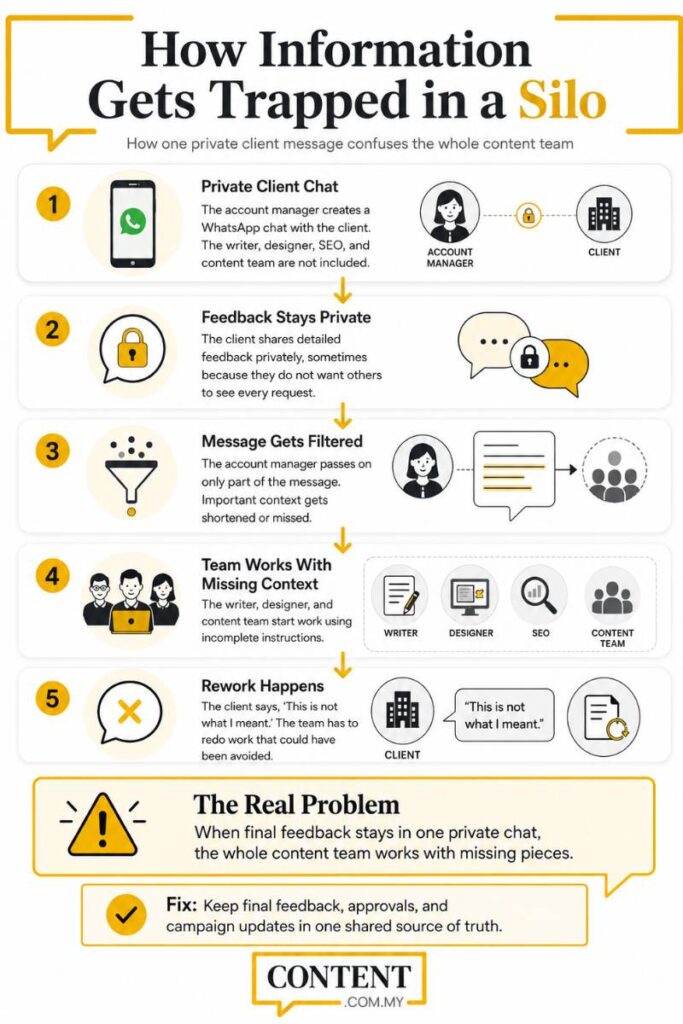
Since then, we have acknowledged the issue and put an internal policy of sharing screenshots of every client message to ensure no context is missing.
How Can Businesses Fix Messy Content Silos?
The fix starts with making information easier to find, not asking everyone to work harder.
DON’T DO MEETINGS, it wastes everyone’s time and everyone would nod along without actually knowing what’s needed.
A memo gives you a cleaner way to pass information from the business to the people creating the content.
Start with these five fixes, this advice is mainly for the content team.
1. Create One Source of Truth
Pick one place for final information.
It can be a shared document, content hub, project management board, or internal folder. The tool matters less than the habit.
This is where the team should find:
- Final campaign details
- Approved offers
- Brand guidelines
- Service notes
- Pricing notes
- Product descriptions
- FAQs
- Customer objections
- CTA instructions
If it is not there, it should not be treated as final.
2. Improve the Content Brief
A content brief should explain why the content exists.
A useful brief answers:
- Who is this for?
- What problem are we solving?
- What should the reader understand?
- What should they do next?
- What business goal does this support?
- What internal information must be included?
- Who approves the final version?
A good brief saves hours of revision later.
3. Assign Clear Owners
Every content piece needs an owner, not five people casually “checking.”
One clear owner.
This person does not need to write everything, but they should know:
- What version is final
- Who needs to review
- What feedback matters
- What deadline is realistic
- What update should be passed to the team
This can be the editor, the account manager or the marketing team, but put 1 person in charge.
4. Bring Sales and Customer Questions Into Content
Sales and customer service teams are sitting on content gold.
They know what people ask before buying. They know what causes hesitation. They know which explanations work. They know which claims create confusion.
Content teams should regularly collect:
- Common sales questions
- Repeated objections
- Customer complaints
- Misunderstood services
- Before-and-after examples
- Proof points from real work
This helps the content sound less like a brochure and more like an answer, seriously, ask the sales team “what do client’s customer want”
5. Make Review Rules Clear
Review chaos is one of the fastest ways to slow a content team down. This is where the blame game starts too and it can be ugly.
Before the draft starts, decide:
- Who checks accuracy?
- Who checks tone?
- Who checks SEO?
- Who gives final approval?
- How many revision rounds are allowed?
- Where should feedback be placed?
Feedback like “make it better” does not help much.
Feedback like “the offer is outdated, replace it with the June promotion and remove the RM500 claim” actually helps the team move.
Read more: 10 ChatGPT Prompts to Improve Your Marketing Strategy
What Should a Content Team Know Before Creating Anything?
Before doing anything, the team should know the latest business context. A simple content context checklist can prevent many mistakes.
At the least, the team should know:
- What is the latest offer, promotion, or service focus?
- What has changed since the last campaign?
- What are customers currently asking?
- What claim or wording should we avoid?
- What proof points can we mention?
- Who is the final reviewer?
- Where is the approved source material?
- What action should the reader take?
This sounds basic and that is exactly why it is often skipped. But skipped basics create expensive rework.

Frequently Asked Questions About Why Content Team Silos
What does it mean when a content team works in silos?
It means writers, designers, SEO specialists, social media teams, and managers work with separate information. Each person may know part of the update, but nobody has the full picture.
Why does my content team keep making the same mistakes?
Repeated mistakes often happen because the source information is unclear, outdated, or scattered. If the brief, feedback, and final updates are not centralised, the same errors can keep returning.
How can businesses improve content team communication?
Start by creating one source of truth, improving briefs, assigning clear owners, and setting review rules before work begins. Tools help, but the process matters more.
Do writers need to know sales and customer feedback?
Yes. Sales and customer feedback help writers understand real questions, objections, and buying concerns. This makes content more useful, specific, and relevant to the reader.
Are WhatsApp groups enough for managing content updates?
WhatsApp is useful for quick communication, but it is weak for final approvals and version control. Important updates should be moved into a shared document, brief, or project board.
How does messy internal communication affect content?
Content becomes generic when keyword research is not supported by business insight. Writers need search intent, customer questions, service details, and proof points to create stronger content.