Key Takeaway
- SEO is not essential for every business. Its value depends on how customers discover and choose your products or services.
- Businesses with search-driven buying journeys benefit most from SEO
- Relying on a single marketing channel is risky. R
- AI search has changed discovery, not eliminated SEO.
- Content remains a long-term business asset.
Table of Contents
SEO is not for everyone.
It’s a long-term marketing channel that often takes 3 to 6 months before meaningful results start appearing. During the early stages, you may spend time creating content, improving your website, and building authority without seeing many enquiries or sales.
For businesses looking for immediate leads next week, SEO is often the wrong solution.
But for businesses willing to invest in long-term visibility, the benefits can compound over time.
So if you’re asking: “Is SEO worth it?”
Our answer is simple: It depends.
In fact, we’ve worked with businesses that genuinely needed SEO, and others that probably didn’t.
- A referral-driven consultant with a waiting list may not need aggressive SEO.
- A government contractor that wins projects primarily through tenders may not need weekly blog content.
- A manufacturer with a stable distributor network may generate little value from ranking for hundreds of keywords.
On the other hand, if your customers actively search online before making a decision, SEO can become one of the most valuable assets your business owns.
“Ask yourself, can your customers find you when they need you? If the answer is no, then you need SEO. If they can, you don’t.”
The Bigger Problem Most Businesses Don’t Realise They Have
Many business owners believe they don’t need SEO because they’re already getting customers. And to be fair, that may be true today.
Perhaps most of your leads come from:
- Referrals
- Existing customers
- TikTok
- Marketplaces
- Paid advertising
And there is nothing wrong with that, but the problem appears when those channels become your only source of visibility.
- If Facebook reduced your reach tomorrow, what would happen?
- If Google Ads became twice as expensive next year, what would happen?
- If your top salesperson left the company, what would happen?
- If referrals slowed down during an economic downturn, what would happen?
Businesses discover they have a marketing problem only when one of their lead sources suddenly disappears.
That’s not to say SEO is the be all end all, goodness no but we often encourage clients to think about discoverability rather than SEO.
The Difference Between Owned Assets and Discovery Channels
One concept we frequently discuss with clients is the difference between owned assets and discovery channels.
Put simply, your business should ideally own the assets while diversifying the channels that help customers discover them.
Owned Assets
These are things your business controls:
- Website content
- Service pages
- Blog articles
- Email lists
- Customer databases
- Knowledge hubs
The value of these assets often compounds over time. A well-written guide, service page, or resource can continue generating traffic and brand awareness years after it was published.
Discovery Channels
These are the platforms people use to find your business:
- Google Search
- ChatGPT
- Gemini
- TikTok
- YouTube
- Online marketplaces
But here’s the thing, you don’t own any of these platforms.
Google can change its algorithm., TikTok can reduce your reach and AI search platforms can change how they surface information (like how they do now)
That’s why we generally advise businesses not to become overly dependent on any single source of visibility.
“SEO plays a role in that strategy because it helps your website, content, and expertise become easier to find. But SEO is only one piece of a much larger discoverability strategy.”
Businesses that combine search, content, social media, email, PR, referrals, and AI visibility are often far more resilient than businesses relying on any single channel. Hence the term, don’t put all of your eggs in one basket.
Which Businesses Actually Need SEO?
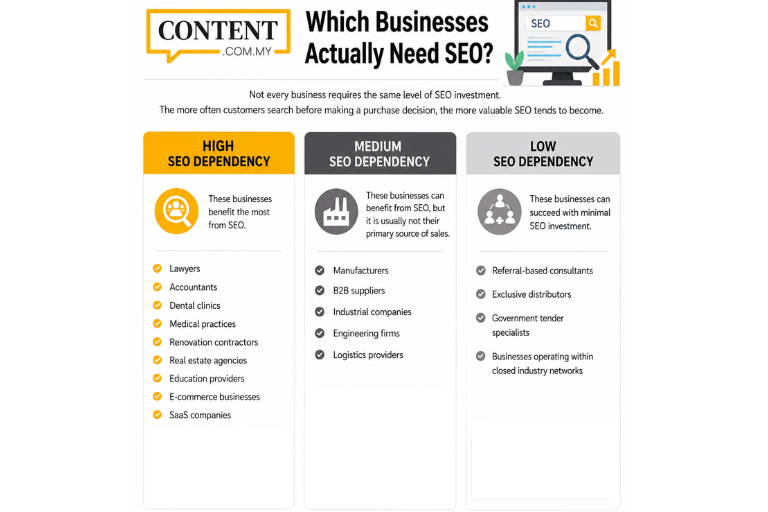
Not every business requires the same level of SEO investment. The more often customers search before making a purchase decision, the more valuable SEO tends to become.
High SEO Dependency
These businesses benefit the most from SEO:
- Lawyers
- Accountants
- Dental clinics
- Medical practices
- Renovation contractors
- Real estate agencies
- Education providers
- E-commerce businesses
- SaaS companies
Why? Because customers are actively researching options before they buy.
A homeowner looking for a renovation contractor in Petaling Jaya is unlikely to pick the first company they hear about. They’ll probably compare websites, reviews, portfolios, and pricing before making enquiries.
The same applies to someone searching for:
- “accountant in Kuala Lumpur”
- “best international school in Selangor”
- “payroll software Malaysia”
- “dental clinic near me”
If your business isn’t visible during that research process, you’re potentially missing customers who are ready to buy.
Medium SEO Dependency
These businesses can benefit from SEO, but it is usually not their primary source of sales:
- Manufacturers
- B2B suppliers
- Industrial companies
- Engineering firms
- Logistics providers
In these industries, purchasing decisions often involve multiple stakeholders, quotations, and long sales cycles.
A factory manager looking for an industrial magnet supplier or warehouse racking system may still conduct online research, but the final decision is rarely made from a single Google search.
That said, SEO can still support:
- Credibility and trust
- Technical content discovery
- Product research
- Lead generation
- International visibility
For many Malaysian manufacturers, ranking for niche industry terms can help attract distributors, procurement teams, and overseas buyers long before direct conversations begin.
Low SEO Dependency
Some businesses can succeed with minimal SEO investment:
- Referral-based consultants
- Exclusive distributors
- Government tender specialists
- Businesses operating within closed industry networks
For example, a consultant who consistently receives referrals from existing clients may have little need to publish dozens of blog articles.
What About AI Search? Doesn’t That Change Everything?
Yes, it does but let’s hold on for a second before we declare the SEO apocalypse.
There’s no denying that AI search has changed how people discover information online. Tools like ChatGPT, Gemini, Perplexity, and Google’s AI Overviews can often answer simple questions without users needing to click through to a website.
So if you’re wondering whether AI has disrupted SEO, the answer is absolutely yes.
Has it killed SEO? Not quite.
- Customers still need answers.
- They still research products.
- They still compare providers before making decisions.
What’s changing is where that discovery happens.
If someone asks ChatGPT for the best accounting software in Malaysia, the AI still needs information to reference. If someone searches for the best renovation contractor in Kuala Lumpur, they still need websites, reviews, case studies, and expertise signals to evaluate.
The businesses appearing in these conversations are often the same businesses that have invested in useful content, demonstrated expertise, and built a credible online presence over time.
In other words, SEO.
Read more: 10 Types of Content Marketing Every Business Should Use
A Simple Test: Do You Need SEO?
Okay so let’s wrap it up, if you’re still on the fence if you need SEO, ask yourself these five questions.
- Are customers searching for your service online?
- Do competitors appear in search results when you don’t?
- Is your business heavily dependent on referrals?
- Are your advertising costs increasing every year?
- Would lead generation suffer if one major channel disappeared?
If you answered “yes” to most of these questions, SEO is probably worth serious consideration.
If you answered “no” to most of them, your resources may be better invested elsewhere.
If SEO Isn’t Worth the Investment, What Is?
So okay your cross out SEO and you still want leads, what else can you do? Well here’s a simplified framework we often use:
Business Situation | Better Investment Than SEO |
New business with no customers yet | Networking and partnerships |
Need leads immediately | Google Ads |
Strong visual product | TikTok and Instagram |
Local service business | Google Business Profile |
High-value B2B service | LinkedIn and relationship building |
Existing customer base | |
Referral-driven business | Customer experience and referrals |
Established brand seeking long-term growth | SEO and content marketing |
For example, if you’ve just launched a new law firm in Kuala Lumpur (and congratulations if you do) and need enquiries this month, Google Ads will likely generate results faster than SEO.
If you’re selling trendy fashion products to younger audiences, TikTok content may outperform blog articles.
If you’re an industrial supplier targeting procurement teams, industry events and relationship-building could generate more opportunities than chasing high search rankings.
SEO is Temporary, Content is Forever
Regardless if you’re pursuing SEO, Google Ads or hitting the griddy with the zoomers on Tiktok, almost every marketing channel has one thing in common:
It runs on content.
- Google needs content to rank.
- AI platforms need content to reference.
- Social media needs content to engage audiences.
- Email campaigns need content to nurture leads.
At Content.com.my, that’s exactly what we help businesses do. Our content marketing agency helps brands create content for websites, social media feeds and their articles.
If you need help with SEO or non-SEO stuff, we’re the right agency for ya.
Or not, we’re not so sure honestly.
Just give us a call and we will get your sorted.

Frequently Asked Questions About Do Business Need to SEO Succeed
Does Every Business Need SEO?
No. Some businesses can grow through referrals, tenders, partnerships, or existing customer networks. SEO matters more when customers actively search online before choosing a provider.
Is SEO Still Worth It In 2026?
Yes, but only when it matches your business goals. SEO is still useful for long-term visibility, but it should not be treated as an instant lead-generation channel.
How Long Does SEO Take To Work?
Most businesses should expect 3 to 6 months before seeing meaningful early results. Competitive industries may take longer, especially if the website has weak content or low authority.
What Should I Invest In If SEO Is Not Suitable?
It depends on your situation. Google Ads, social media, partnerships, referrals, email marketing, or Google Business Profile optimisation may deliver better short-term results.
Has AI Search Replaced SEO?
No. AI search has changed how people discover information, but businesses still need useful content, expertise signals, and online authority to appear across search and AI platforms.
Why Is Content Important For SEO?
SEO depends on content. Strong service pages, articles, guides, and case studies help search engines, AI tools, and customers understand why your business is relevant and trustworthy.