A pillar page is a centralized masterpiece of content that covers a broad topic in depth and links to a group of related, detailed sub-topic pages called topic clusters. Instead of publishing scattered blog posts, you create an organized “knowledge hub” that signals expertise to both human readers and search engine algorithms.
In an era where AI Search and SGE (Search Generative Experience) prioritize “Expertise” and “Trust,” having a messy site is a quick way to invisibility.
Hence today, a professional content marketing agency in Malaysia will simplify the architecture of a pillar page, on what it is and how even junior writers can write like a pro.
Comparison: Traditional Blogging vs. The Pillar & Cluster Model
Feature | Traditional Blogging | Pillar & Cluster Model |
Organization | Chronological (Newest first) | Logical (Topic-based hubs) |
Internal Linking | Random or nonexistent | Strategic “Hub and Spoke” |
Authority | Hard to prove expertise | Demonstrates deep topical authority |
UX Quality | Readers get lost easily | Clear “learning path” for users |
AI Readiness | Moderate (Harder for LLMs to map) | High (Optimized for AI Summaries) |
Why Is the Pillar Page Model Better for Modern SEO?
The pillar and cluster model builds topical authority, which is what modern search engines prioritise over isolated keywords.
It Aligns With How Search Engines Now Understand Content
Search engines no longer reward keyword repetition. They evaluate:
- Topic depth
- Content relationships
- Entity connections
- Internal linking structure
When you organise content into a pillar page supported by tightly related cluster articles, you signal expertise across an entire subject area, not just a single keyword variation.
As many SEO strategists put it:
“Search is moving from strings to things. Google looks at entities and the relationships between them, not just isolated keywords.”
Clusters create that relationship map, and for writing the best content in your market.
It Strengthens Topical Authority
Think of your website like a library.
- A traditional blog strategy is a pile of books on the floor.
- A pillar model is a clearly labelled bookshelf with structured sections.
For example:
Pillar Page: “Ultimate Guide to Home Ownership in Malaysia”
Cluster Articles:
- EPF Account 2 for Housing
- Stamp Duty Costs in Malaysia
- MRTA vs MLTA Comparison
- First-Time Home Buyer Schemes
- What is SPA (Sales Purchase Agreement)
When Google or AI systems like Gemini crawl your site, they see a structured ecosystem with relationships. That structure proves depth, credibility, and subject mastery.
It Improves Internal Linking Power
Instead of scattered blog posts competing with each other, the model:
- Channels authority toward one core page
- Reduces keyword cannibalisation
- Helps both users and bots navigate logically
- Improves crawl efficiency
Each cluster reinforces the pillar. Each internal link has a purpose.
Scenarios: A boutique digital agency in Kuala Lumpur wants to rank for “Social Media Marketing.”
Instead of publishing five unrelated TikTok posts, they build:
Pillar Page: “The Complete Guide to Social Media for Malaysian SMEs”
Supporting Clusters:
- TikTok Shop Integration in Malaysia
- Facebook Ads for Local F&B Brands
- KOL Marketing in Southeast Asia
- Budgeting Social Ads for SMEs
This tells Google the agency understands the full ecosystem, not just one trend. The result is stronger authority, broader keyword coverage, and better long term ranking stability.
Modern SEO rewards:
- Structured knowledge
- Clear topical hierarchies
- Entity depth
- Contextual linking
The pillar model delivers all four.
“In a large-scale analysis of 11.8 million Google search results, content that covers topics comprehensively and ranks on the first page tends to be longer and more detailed, with an average of about 1,447 words.” – Backlinko
What Are the Different Types of Pillar Pages?
Pillar pages can educate, organise resources, or drive conversions, depending on your business goal.
Most pillar pages fall into three main categories.
1. The 101 Guide
Best for: Education and awareness
Content style: Definitions, fundamentals, frameworks
This is the most common format. It introduces a topic from the ground up and supports it with related cluster content.
Ideal for:
- Financial literacy
- Digital marketing basics
- Industry explainers
2. The Deep Dive
Best for: Demonstrating expertise
Content style: Advanced frameworks, technical walkthroughs, strategic breakdowns
This format works well if your audience already understands the basics and needs detailed, implementation-level insight.
Ideal for:
- Technical SEO audits
- Enterprise compliance guides
- Advanced investment strategies
3. The Resource Hub
Best for: Utility and navigation
Content style: Curated tools, templates, checklists, directories
Instead of long explanations, this pillar acts as a central command centre.
Ideal for:
- Tool roundups
- Download libraries
- Industry resource directories
4. The Service Pillar (Highly Effective for Agencies)
Best for: Lead generation and conversion
Content style: Education blended with service positioning
For many Malaysian agencies, this is the most powerful model. It explains:
- What the service is
- Why it matters
- How it works
- Common mistakes
- Pricing expectations
While educating the reader, it gently moves them further down the sales funnel, neat huh?
Pillar Type | Primary Goal | Content Depth | Conversion Focus |
101 Guide | Awareness | Foundational | Low to Medium |
Deep Dive | Authority | Advanced | Medium |
Resource Hub | Utility | Curated | Low |
Service Pillar | Lead Generation | Educational + Sales | High |
Just remember to choose the right type depending on your objective.
- If your goal is traffic, start with a 101 guide.
- If your goal is revenue, a service pillar often performs best.
How Do You Build a Topic Cluster from Scratch?
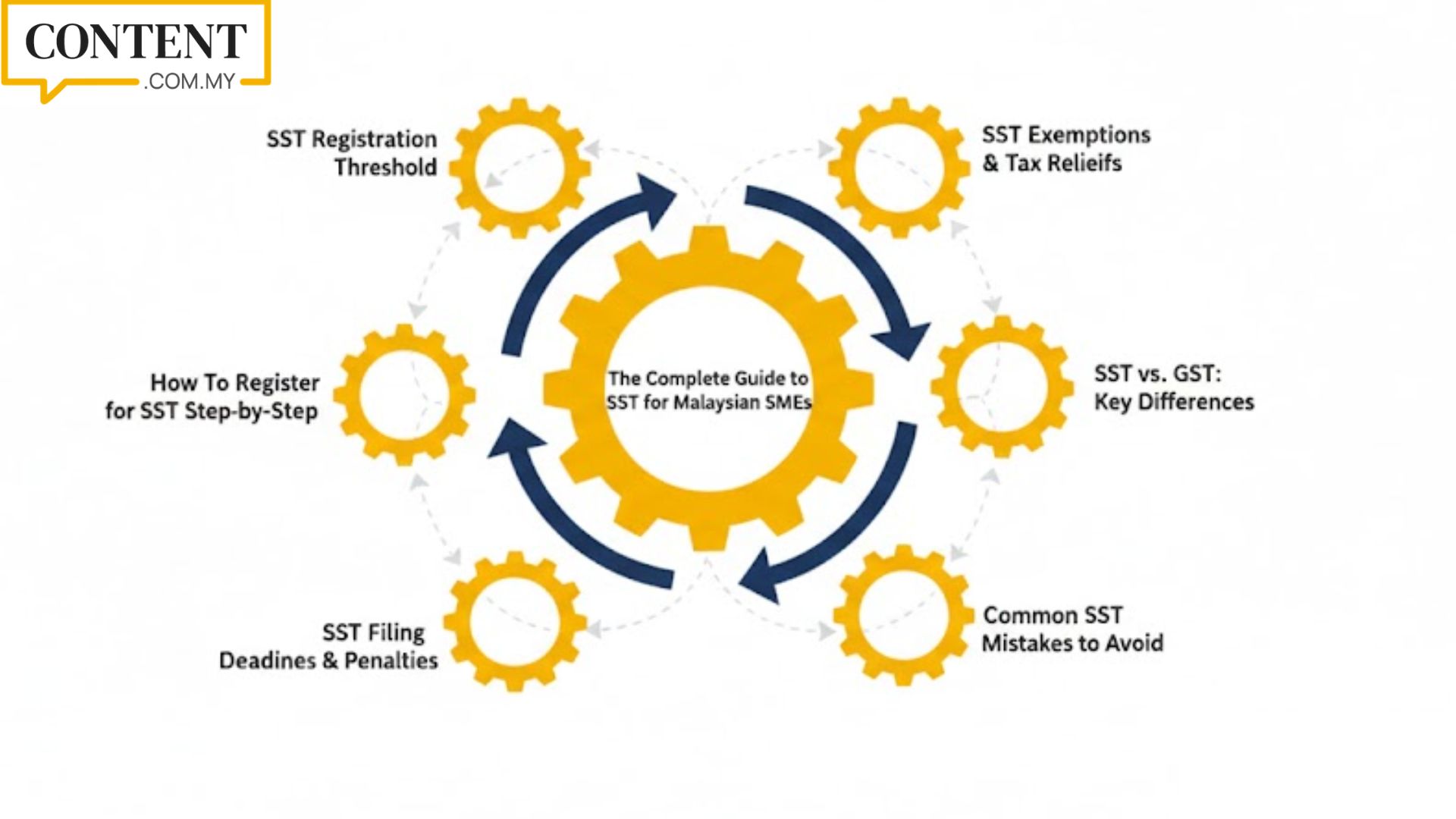
Create one central pillar page, then surround it with tightly related cluster articles, all connected through intentional internal linking.
This is known as a Hub and Spoke structure.
Step 1: Define Your Pillar (The Hub)
Your pillar should:
- Target a broad, high value topic
- Align with a core business offering
- Support at least 5 to 10 meaningful subtopics
- Solve a complex, multi step problem
Ask yourself:
- Is this topic commercially relevant?
- Can it anchor long term authority?
- Would ranking this term influence revenue, not just traffic?
Example Pillar: “The Complete Guide to SST for Malaysian SMEs”
This is broad, practical, and directly tied to compliance and advisory services.
Step 2: Extract Real Subtopics (The Spokes)
Now break the pillar into focused, intent driven questions.
Where to find them:
- People Also Ask
- Google autocomplete
- SME Facebook groups
- Sales objections
- Client FAQs
- Internal search data
Each cluster should answer one clear question.
Example Cluster Topics:
- What Is the SST Registration Threshold in Malaysia?
- How to Register for SST Step by Step
- SST Filing Deadlines for SMEs
- Common SST Mistakes That Trigger Penalties
- SST vs GST: Key Differences
Each becomes its own standalone article.
Step 3: Write the Pillar Strategically
Your pillar is not just a long article.
It should:
- Briefly introduce each cluster topic
- Summarise it in 2 to 4 sentences
- Include contextual internal links
Example inside the pillar:
“Understanding the SST registration threshold is critical before applying. Read our full guide on SST Registration Thresholds to determine if your business qualifies.”
The pillar must link to every cluster article.
Step 4: Write Each Cluster with Context
Each cluster article should:
- Fully answer its specific question
- Include at least one contextual link back to the pillar
- Reinforce the broader topic
Example inside a cluster:
“If you are new to SST compliance, start with our Complete Guide to SST for Malaysian SMEs to understand the overall framework.”
That link completes the authority loop.
Step 5: Build the Link Circle
This is where execution matters most.
Pillar → Cluster
Does the main guide link to every supporting article?
Cluster → Pillar
Does every cluster link back to the main guide?
Cluster → Cluster (Optional but Powerful)
Do related subtopics link to each other where relevant?
When this circle is complete, search engines clearly see:
- Topic hierarchy
- Content relationships
- Authority depth
- Intent alignment
Step 6: Maintain Structure and Avoid Chaos
Avoid these common mistakes:
- Linking randomly to unrelated posts
- Creating overlapping clusters targeting the same keyword
- Publishing new clusters without updating the pillar
- Letting outdated cluster content remain unlinked
Every time you publish a new cluster, update the pillar to reflect it.
Mastering the Content Strategy for Your Website
When your website builds logical hubs, both users and search engines can clearly understand what you specialise in.
Readers move naturally from awareness to deeper education, then toward solutions. Search engines recognise topic depth, relationships, and expertise. It’s a win.
At Content.com.my, our copywriting services are built around this exact framework. We do not write isolated blog posts, instead we design strategic topic clusters that function as a funnel, attracting the right traffic and guiding prospects toward conversion.
If you want content that generates leads instead of just page views, a properly engineered pillar and cluster strategy is where it begins.
“Because traffic is nice, but qualified leads pay the bills.”