Key Takeaway
- Shoppers often decide whether to buy within 2–3 seconds, especially on Shopee, Lazada, and TikTok Shop.
- Strong product descriptions combine a hook, benefit-driven bullets, and trust signals.
- Malaysian shoppers respond well to localized language, social proof, and certifications.
- AI tools can speed up writing, but human editing is essential for authenticity and persuasion.
- Platform optimization differs across Shopee, Lazada, and TikTok Shop.
Table of Contents
A product description that sells uses three important elements: a strong hook, benefit-driven bullet points, and clear trust signals that reduce buyer hesitation.
When written properly, this format can significantly improve conversions on platforms like Shopee, Lazada, and TikTok Shop.
In Malaysia’s competitive eCommerce marketplaces, hundreds of similar products appear side by side. The listings that win are usually the ones that communicate value quickly and clearly.
Simply put, a strong product description typically does three things:
- Captures attention immediately
- Converts features into real-life benefits
- Builds trust through social proof and authority signals
So, let our content marketing agency teach you how.
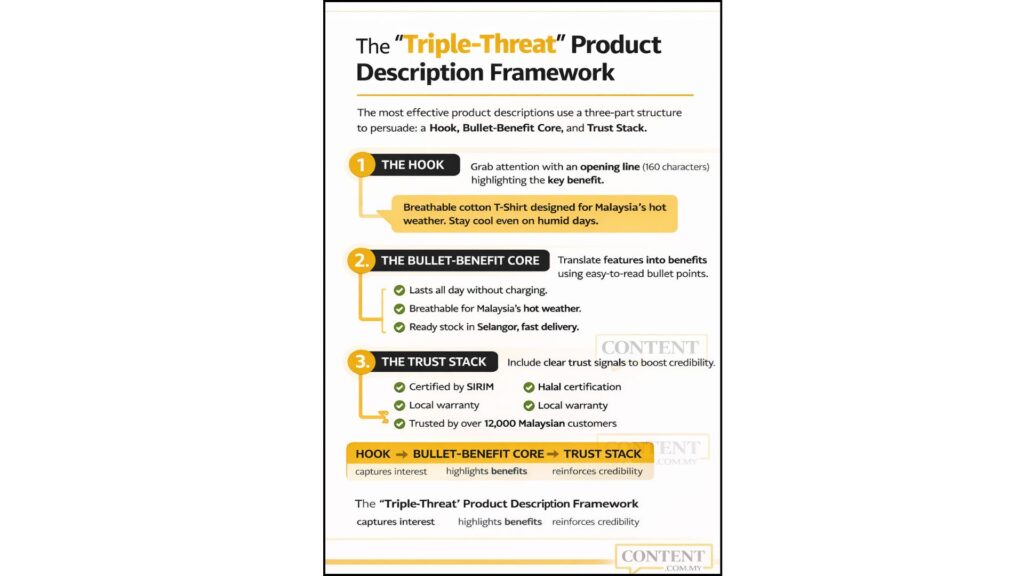
The “Triple-Threat” Product Description Framework
The most effective product descriptions follow a three-part structure: a strong hook, benefit-driven bullet points, and a trust stack.
This framework mirrors how shoppers evaluate products.
- First they scan the opening line
- Then skim the benefits
- Finally look for trust signals before deciding to purchase.
1. The Hook (First 160 Characters)
The first sentence must immediately answer the shopper’s core question: “Why should I care?”
For mobile shoppers, especially on TikTok Shop or Shopee, the hook often determines whether the rest of the description is even read.
Example:
❌ Weak
High quality cotton T-shirt with comfortable fit.
✅ Strong
Breathable cotton T-shirt designed for Malaysia’s hot weather. Stay cool even on humid days.
The stronger version instantly connects the product to a real and local problem: heat and humidity.
2. The Bullet-Benefit Core
Shoppers rarely read long paragraphs. Instead, they skim short bullet points that highlight benefits.
The rule is simple, translate features into lifestyle outcomes.
Example:
Feature | Weak Description | Benefit-Driven Description |
Battery | 5000mAh battery | Lasts all day without charging |
Fabric | Cotton material | Breathable for Malaysia’s hot weather |
Shipping | Ships in 2 days | Ready stock in Selangor, fast delivery |
Benefit-focused descriptions help customers visualize how the product improves their daily life.
3. The Trust Stack
After evaluating the benefits, shoppers look for signs or reassurance that confirm the product is reliable.
Common Malaysian trust signals include:
- SIRIM certification (especially for electronics)
- KKM approval
- Halal certification
- Local warranty
- Sales volume (10,000+ units sold)
For example: Trusted by over 12,000 Malaysian customers. Certified by SIRIM and backed by a 12-month local warranty.
These elements reduce hesitation and reinforce credibility.
Should Product Descriptions Mix Bahasa Melayu and English?
A bilingual approach often increases conversion rates because Malaysian shoppers naturally switch between English and Bahasa Melayu.
Many successful listings combine both languages because it feels more conversational and relatable.
For example: Lightweight sambal grinder that’s easy to use. Memang puas hati untuk masakan harian.
This language mix works because it mirrors how many Malaysians speak in everyday situations.
However, balance is important. Too much slang or Manglish can make the brand look unprofessional, especially for premium products.
A helpful rule:
Product Type | Tone Style |
Food / Lifestyle | Friendly, conversational |
Beauty / Health | Professional with warmth |
Electronics | Clear, technical, trustworthy |
This allows businesses to maintain credibility while still sounding approachable.
How Should Product Descriptions Be Optimized for Different E-commerce Platforms?
Each eCommerce platform rewards slightly different writing styles, formatting strategies, and buyer triggers.
But they do follow a similar pattern, so understanding how shoppers discover products on each platform can significantly improve conversions.
Shopee and Lazada
These marketplaces rely heavily on search keywords and descriptions because most purchases begin with product search.
Best practices include:
- Place important keywords near the beginning
- Use bullet points for easy scanning
- Break text into short sections for mobile viewing
- void obvious keyword stuffing
Modern marketplace algorithms increasingly prioritize semantic relevance and readability rather than repetitive keyword placement.
Shopify (Your Own Website)
Shopify product pages behave more like traditional SEO pages, where both search engines and customers evaluate the content.
Unlike marketplaces, Shopify descriptions should also support organic Google rankings and brand storytelling.
Best practices include:
- Include primary SEO keywords naturally in the description
- Use short paragraphs and benefit-driven sections
- Add trust signals such as warranties, certifications, or reviews
- Align the description with product images and FAQs
Because Shopify stores rely heavily on organic search traffic, clear descriptions can improve both SEO visibility and conversion rates.
TikTok Shop
TikTok Shop works differently because video content drives discovery and purchase decisions.
Descriptions should complement the video rather than repeat it.
Example structure:
- Hook tied to the video content
- 3 to 5 quick benefits
- Closing urgency trigger
Example closing line: Limited stock for today’s livestream promo. Add to cart before the voucher expires.
Urgency works especially well in live selling environments, where viewers often make quick purchase decisions.
Can AI Help Write Better Product Descriptions?
AI can dramatically speed up product description writing which can take a LOT of time, but results depend heavily on the quality of the prompt.
Generic prompts often produce bland descriptions that sound robotic.
Example:
❌ Weak prompt
Write a product description for a water bottle.
This usually produces generic results.
A stronger prompt introduces context, audience, and tone.
Example High-Quality AI Prompt
Act as a top-tier Malaysian eCommerce strategist.
Write a product description for [Product Name].
Target audience: [Age group / lifestyle]
Location: Malaysia
Include:
– A compelling opening hook
– 5 benefit-driven bullet points
– A friendly yet professional tone
– Mention relevant certifications such as SIRIM or Halal if applicable
– Optimize for [Platform] mobile readability
This type of prompt helps AI produce far more usable content.
What Does a Good Product Description Look Like?
The difference between an average description and a persuasive one is clarity and relevance.
Feature | Old Style | Persuasive Style |
Material | 100% Cotton | Breathable cotton suitable for Malaysia’s hot weather |
Shipping | Ships in 2 days | Ready stock in Selangor, fast delivery |
Size | Small / Medium / Large | Malaysian standard fit with size chart |
The persuasive version explains why the feature matters, not just what it is.
“You want to hit hard at the target audience and their needs.”
How Can Sellers Build Trust Through Product Descriptions?
Trust is often the deciding factor in online purchases.
Malaysian buyers are especially sensitive to authenticity because counterfeit products are still common in online marketplaces.
A recent study on Malaysian online consumer behavior found that 44.9% of respondents identified counterfeit goods as one of the major trust concerns in online shopping.” – RSIS
To increase credibility, product descriptions should mention:
- Certifications (SIRIM, KKM, Halal)
- Local warranties
- Customer reviews or sales numbers
- Product images or UGC photos
Trust is a currency few sellers can claim to have!
Checklist: Fix Your Product Description in 5 Minutes
Before publishing a product listing, run through this quick checklist:
✔ Does the first sentence clearly explain the main benefit?
✔ Are features converted into real-life benefits?
✔ Are the bullet points easy to scan on mobile?
✔ Does the listing include trust signals or certifications?
✔ Is the language natural and locally relatable?
Even small improvements can significantly improve conversion rates.
Conclusion: Writing Product Descriptions That Actually Convert
The most successful listings quickly answer the shopper’s main question:
“How does this product make my life better?”
When descriptions highlight benefits, communicate value clearly, and build trust, they can significantly improve both search visibility and conversion rates across marketplaces.
For many online sellers, however, writing persuasive descriptions consistently can be challenging, especially when managing large product catalogs or multiple platforms.
That’s where professional SEO copywriting makes a difference. At Content.com.my, we help eCommerce brands and online sellers create product descriptions that are optimized for both SEO visibility and buyer psychology, turning product pages into powerful sales assets.
Whether you’re launching a new store or improving existing listings, our copywriting services help transform ordinary product descriptions into conversion-focused content that drives real sales.

Frequently Asked Questions About How to Write Product Descriptions
How Long Should a Product Description Be?
A good product description is typically 100 to 300 words, depending on the product complexity. Simple items only need a short hook and bullet benefits, while technical products may require more detail.
What Makes a Product Description Persuasive?
Persuasive descriptions focus on benefits instead of features. Instead of listing specifications, explain how the product improves the customer’s daily life.
Should Product Descriptions Include Keywords?
Yes. Keywords help search engines and marketplace algorithms understand the product. However, modern platforms prioritize natural language and semantic context, so keywords should appear naturally rather than being repeated excessively.
Can AI Write Good Product Descriptions?
AI can generate strong first drafts quickly, especially when given detailed prompts. However, the best results still come from human editing.
What Are the Most Important Elements of a Product Description?
The most effective descriptions contain three elements: a strong opening hook, benefit-driven bullet points, and trust signals such as certifications, warranties, or social proof.
Do Product Descriptions Affect SEO Rankings?
Yes. Search engines analyze product descriptions to understand relevance and quality. Clear descriptions that include keywords, structured formatting, and helpful information can improve organic visibility, click-through rates, and conversions.