Key Takeaway
- A digital marketing funnel turns traffic into structured, measurable revenue
- Funnels are no longer linear, buyers move across multiple touchpoints
- Each stage requires different content, messaging, and KPIs
- Most businesses fail due to poor lead qualification and funnel leakage
- Conversion optimisation matters more than traffic volume
Table of Contents
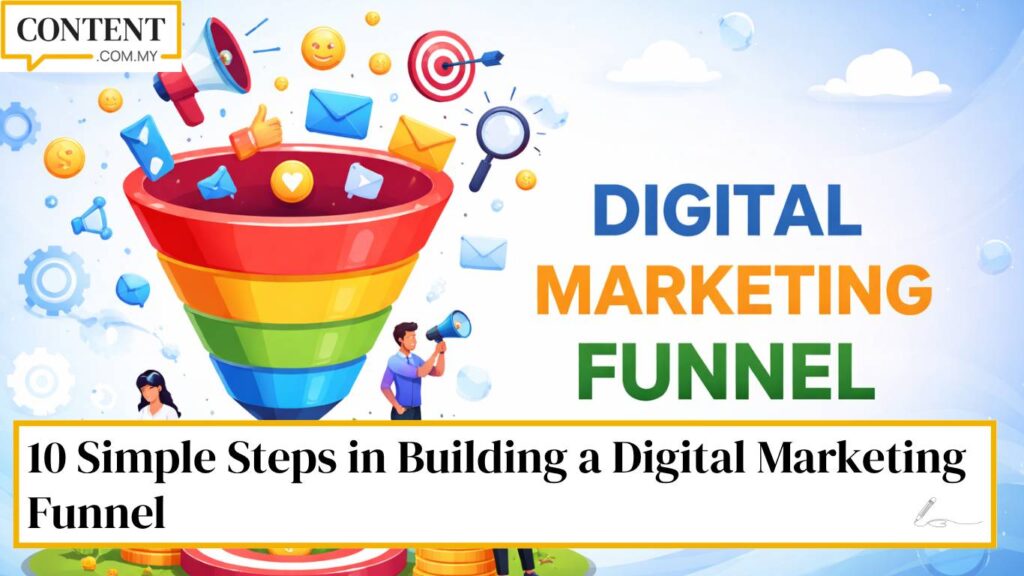
A digital marketing funnel is not just a diagram, it is a system that guides potential customers from awareness to purchase and beyond. In simple terms, it maps how strangers become leads, and how leads become paying customers.
At its core, the funnel reflects the customer journey, moving from awareness to interest, evaluation, and finally action or purchase.
However, with AI and new technologies, funnels are no longer linear. Buyers jump between channels, revisit stages, and make decisions based on multiple touchpoints across Google, social media, and even ChatGPT locations.
This is why building a funnel today is less about theory, and more about execution, tracking, and conversion strategy.
How the Modern Funnel Actually Works
Today’s funnel behaves more like a loop than a straight line.
Traditional model:
Awareness → Interest → Decision → Action
This is the aforementioned AIDA model.
However, today’s buyers behave very differently from the traditional funnel model.
They no longer move in a straight line. Instead, they:
- Have multiple entry points (Google, social media, ads, marketplaces)
- Move non-linearly between stages
- Require repeated touchpoints before making a decision
Buyers may:
- Discover you via SEO
- See your ad on social media
- Check reviews or testimonials
- Compare competitors
- Leave without buying
- Return days or even weeks later through retargeting
Take a simple, everyday scenario:
Aidil sees a Facebook ad for a fast-charging phone charger while scrolling during lunch.
He clicks, but does not buy immediately.
Later that night, he:
- Searches on Google to check if the brand is reliable
- Opens Shopee to compare prices
- Reads product reviews and ratings
- Checks if there are vouchers or free shipping
Still unsure, he leaves.
Two days later:
- He sees a retargeting ad offering a discount
- Returns to Shopee
- Completes the purchase
What this means: Your funnel must be designed to support repeated, multi-channel interactions, not just a one-time linear path.
1. Define Your Ideal Customer
You cannot build a funnel if you don’t know who it is for.
Start by clearly defining:
- Industry: What sector are they in, and what problems are common there
- Budget level: Can they realistically afford your solution
- Pain points: What problem are they actively trying to solve
- Decision-makers: Who influences or approves the purchase
In B2B, buying decisions often involve multiple stakeholders, such as managers, finance teams, and directors, which makes targeting more complex and messaging more layered.
2. Map the Customer Journey
Understand how your customer discovers, evaluates, and buys.
You are not mapping your business process, you are mapping their decision process.
Ask:
- Where do they search (Google, social, marketplaces)?
- What triggers their interest or urgency?
- What objections or doubts do they have before buying?
The goal is to identify key touchpoints so you can place the right content at the right moment.
3. Create Awareness Channels
Bring traffic into the funnel through discoverability.
Focus on channels where your audience already spends time:
- SEO (Google search intent-driven traffic)
- Social media (scroll-based discovery)
- Paid ads (targeted reach and speed)
Many businesses over-invest here, driving traffic without a clear funnel behind it, which leads to high spend but low conversion.
4. Build TOFU Content
Attract attention with educational, problem-focused content.
Your goal here is visibility, not selling.
Examples:
- “What is…” guides
- Industry insights or trends
- Blog articles answering common questions
This content positions your brand early in the journey and builds awareness before competitors even enter consideration.
Even this blog, yes the one you’re reading right now, is also building towards that funnel!
5. Capture Leads (Lead Magnets)
Turn traffic into leads using value exchange.
Instead of letting visitors leave, give them a reason to stay connected with lead magnets:
- Free guides or downloadable resources
- Checklists or templates
- Webinars or workshops
- Email subscriptions
This is where anonymous visitors become trackable prospects you can nurture over time.
6. Segment and Qualify Leads
Not all leads are equal, and treating them the same reduces efficiency.
Break them into:
- MQL (Marketing Qualified Leads): Interested but not ready
- SQL (Sales Qualified Leads): Ready to buy or evaluate
You can qualify leads based on:
- Behaviour (pages visited, actions taken)
- Demographics (industry, company size, budget fit)
- Engagement level (email opens, repeat visits)
Without proper qualification, sales teams waste time chasing low-intent leads, while high-value prospects may be neglected.
7. Build MOFU Nurturing System
Educate and build trust over time instead of pushing for immediate sales.
Use:
- Email sequences: Deliver structured education over time (problem → solution → proof)
- Retargeting ads: Stay visible after users leave your site
- Case studies: Show real-world results and reduce perceived risk
You can also include:
- Comparison guides
- FAQs addressing objections
- Industry-specific insights
B2B buyers often require multiple exposures because decisions involve higher costs, risk, and internal approval processes.
8. Create High-Converting BOFU Assets
Remove friction and make it easy for prospects to decide.
Focus on:
- Clear, focused landing pages
- Testimonials and social proof
- Transparent pricing or packages
- Sales demos or consultations
You should also address:
- Common objections
- Implementation concerns
- Expected outcomes
This is where most revenue is won or lost. Even small improvements, such as clearer messaging or stronger proof, can significantly increase conversion rates.
9. Track Funnel Metrics
If you cannot measure your marketing ROI, you cannot improve it.
Metrics to monitor:
- Traffic → Lead conversion rate: Indicates how effective your offer and landing pages are
- Lead → Customer conversion rate: Reflects sales effectiveness and lead quality
- Customer acquisition cost (CAC): Total cost to acquire one customer
- Customer lifetime value (CLV): Total revenue generated per customer over time
You can also track:
- Cost per lead (CPL)
- Funnel drop-off rates
- Channel-specific performance
These metrics help you pinpoint exactly where performance drops, so you can optimize the right stage instead of guessing.
10. Optimise Funnel Leakage
Every funnel has leakage, but the idea is identifying where and why it happens.
Common patterns:
- High traffic, low leads: Weak offer, unclear messaging, or poor landing page design
- Many leads, low sales: Poor qualification, weak nurturing, or misaligned expectations
- Strong interest, no conversion: Lack of trust, unclear pricing, or unresolved objections
To fix leakage:
- Improve messaging clarity
- Strengthen offers or incentives
- Refine targeting and qualification
- Enhance trust signals (reviews, case studies)
Note! The funnel is not a one-time setup. The purpose is to act as a diagnostic system that continuously identifies and fixes conversion gaps over time.
Simple Funnel Framework
Stage | Objective | Content Type | KPI |
TOFU | Awareness | Blogs, SEO content | Traffic |
MOFU | Consideration | Case studies, emails | Leads |
BOFU | Conversion | Landing pages, demos | Sales |
Targeting the Malaysian Audience
Building a digital marketing funnel in Malaysia requires adapting to local behaviour, platforms, and not just copying global strategies.
Malaysian buyers do not follow a purely Google-driven journey. Instead, they move across multiple platforms, often blending search, social, and marketplace behaviour before making a decision.
Malaysian users commonly:
- Search on Google for initial research
- Browse social media (Facebook, Instagram, TikTok) for discovery
- Compare products on Shopee or Lazada
- Communicate directly via WhatsApp before purchasing
This means your funnel must extend beyond your website and exist across multiple ecosystems, not just one channel.
Trust Is a Major Conversion Driver
Malaysian consumers are highly:
- Review-driven
- Price-sensitive
- Comparison-focused
They often:
- Read multiple reviews before deciding
- Compare sellers across platforms
- Look for social proof such as testimonials and ratings
Price Sensitivity and Value Perception
Unlike some Western markets, Malaysian buyers tend to:
- Prioritise deals, bundles, and perceived value (Double 11 and Raya promotions)
- Wait for promotions or discounts
- Compare across multiple sellers before committing
Your funnel should include:
- Clear value propositions
- Promotions or incentives
- Competitive positioning
WhatsApp as a Conversion Channel
Prioritise Whatsapp, we cannot stress this enough.
Buyers often:
- Ask questions before purchasing
- Request quotes or clarification
- Build trust through direct interaction
This makes WhatsApp an important MOFU to BOFU bridge, especially for service-based and B2B businesses.
Local Constraints and SME Reality
Many Malaysian businesses operate with:
- Limited marketing budgets
- Small teams handling multiple roles
- Heavy reliance on paid ads without structured funnels
This makes it even more important to:
- Focus on conversion efficiency, not just traffic
- Build systems that maximise ROI at every stage
Conclusion on Digital Marketing Funnels
A digital marketing funnel is not just a marketing concept, it is the engine that converts attention into revenue. Businesses that succeed are not those with the most traffic, but those with the most efficient, well-structured funnels.
If you are struggling with inconsistent leads or poor conversions, it usually means your funnel is incomplete but fear not, for we have a proposition!
Our Content marketing agency understands how Malaysian audiences actually search, evaluate, and decide.
We design content marketing strategies that align with each stage of the customer journey, helping businesses not just attract traffic, but build trust, nurture leads, and convert consistently through content.
If you are reading this now, it means our funnel worked, so why not take it the next step? Drop us an email and let’s work something out.

Frequently Asked Questions About Digital Marketing Funnel
What is a digital marketing funnel in simple terms?
A digital marketing funnel is the process of turning strangers into customers through stages like awareness, consideration, and conversion.
How many stages are in a marketing funnel?
Most funnels have 3 to 6 stages, but the most common model is TOFU, MOFU, and BOFU.
Is a funnel still relevant in 2026?
Yes, but it is no longer linear. Modern funnels are multi-channel and dynamic.
What is the difference between a funnel and a pipeline?
A funnel represents the buyer journey, while a pipeline represents internal sales processes.
What is the biggest mistake in building a funnel?
Focusing only on traffic instead of conversion and lead nurturing.
Do small businesses need a funnel?
Yes. Even simple funnels help SMEs improve conversions and reduce wasted marketing spend.