Key Takeaway
- Search engines now prioritize problem-solving content, not keyword repetition.
- Slow websites lose visitors quickly and struggle to rank in search results.
- Local SEO signals help Malaysian businesses capture regional traffic.
- E-E-A-T signals such as expert authorship and trusted sources improve credibility.
- Content with headings, lists, and tables improves visibility in AI search results.
Table of Contents
Most websites receive little traffic because their content does not match search intent, their pages load slowly, or they lack strong SEO signals such as topical authority and local relevance.
Many Malaysian SME websites contain only basic corporate pages such as Home, About Us, Services, and Contact Us. While these pages build credibility, they rarely answer the questions potential customers search for online.
Websites that attract search traffic usually publish SEO copywriting content that addresses customer concerns, pricing questions, technical problems, or regulatory requirements relevant to their industry.
Without this type of content, search engines have little reason to display the website in results.
What Are The Most Common Reasons A Website Gets No Traffic?
Low traffic is usually caused by a combination of technical issues, weak content coverage, and poor search intent alignment.
Common traffic problems include:
- Content targeting broad keywords instead of real questions
- Websites with fewer than 10 indexed pages
- Slow page speed caused by heavy images or poor hosting
- Weak local SEO signals such as missing city references
- No E-E-A-T signals such as authorship or trusted citations
For example, an accounting firm website may only contain pages titled “Services” or “About Us”.
However, potential clients search for queries such as “how to register a Sdn Bhd in Malaysia” or “company secretary requirements Malaysia.”
If a website does not answer those queries, search engines have nothing to rank or anything to lead them to your site. As Keith, our head of content would put it:
“Search engines see blogs as your knowledge base, if you write topics for what people are actually searching for, the search engine would see you as an expert in that field and reward your site.”
The Traffic Recovery Matrix
Factor | Impact Level | Primary Problem | Recommended Fix |
Search Intent | Critical | Content answers the wrong questions | Map headings to “How” and “Why” queries |
Page Speed | High | Large images and unoptimized hosting | Convert images to WebP and use CDN |
Local SEO | High | Missing Malaysian location signals | Add city names and service areas |
AI Readiness | Medium | Unstructured paragraphs | Use lists, headings, and tables |
E-E-A-T | Medium | Weak credibility signals | Add expert authors and citations |
Why Is Your Website Failing The Search Intent Test?
Search engines prioritize pages that solve the exact problem users are searching for.
Many websites focus on describing services instead of answering questions customers actually ask.
For example, a renovation contractor targeting “interior design Malaysia” faces intense competition, especially when they are a new startup.
Thus, a better approach is targeting questions such as:
- Kitchen cabinet renovation cost Malaysia
- Condominium renovation rules Malaysia
- Bathroom renovation timeline Malaysia
Although more specific and less overall search volume, these queries reflect customer concerns and often lead to higher conversions.
Slow Loading Speed Kills Your Traffic
Slow websites increase bounce rates and reduce rankings because page speed is a major search ranking factor.
Imagine clicking on a website and it takes more than 2 seconds to load, most users would click the “back” button and click on another site.
Common causes of slow websites include:
- Large image files
- Heavy page builders
- Multiple tracking scripts
- Low-quality hosting servers
“Websites loading within two seconds generally experience higher engagement and conversion rates” – Google Web Performance Research).
Specifically, mobile performance is critical because 97% of Malaysian users access the internet through smartphones.
Are You Missing Out On Local Malaysian Traffic?
Local SEO helps businesses capture search demand from nearby customers.
Search engines use geographic signals to determine if a business is relevant to users in a specific area.
If your website does not mention service locations or local context, search engines may assume your business is generic or not tied to a specific area.
Businesses can strengthen their local SEO signals by:
- Mentioning cities such as Klang, Johor Bahru, Penang, or Kuching within their content
- Embedding Google Maps showing the office or service location
- Optimizing the Google Business Profile with updated contact details and operating hours
- Referencing nearby landmarks, business districts, or industrial zones
For example, a dental clinic targeting the keyword “dentist” competes with thousands of global websites.
However, a clinic optimizing for “dentist Subang Jaya” or “Klinik Pergigian Shah Alam” competes within a smaller, more relevant local market.
Adding location-specific keywords helps search engines understand that the business serves users in that area!
How Much Content Does A Website Need To Get Traffic?
Websites gain search visibility by building topical authority through multiple pages covering related questions within an industry.
In simple terms, the more useful topics your website covers, the easier it is for search engines to understand what your business specialises in.
Website Content Coverage
Website Type | Number Of Pages |
Basic SME website | 5 to 10 pages |
SEO optimized website | 40 to 100 pages |
Authority industry website | 200+ pages |
Now, this does not mean you need to suddenly create 50 separate service pages. Most businesses grow their content naturally by answering common customer questions related to their services using blogs.
For example, an accounting firm might expand its website with helpful guides such as:
- SST registration requirements in Malaysia
- Sdn Bhd compliance checklist
- Tax deduction rules for SMEs
- Differences between audit and tax filing
Each article targets a specific question someone might search for. As these pages accumulate, the website gradually builds topical authority in accounting and compliance.
Over time, search engines begin associating the website with expertise in that subject area, making it easier for both educational articles and service pages to rank.
In fact, we have a whole blog on A Guide to Writing Website Content that Generates Sales!
How Do Weak E-E-A-T Signals Hurt Your Rankings?
Search engines prioritize websites that demonstrate expertise and credibility.
E-E-A-T stands for Experience, Expertise, Authoritativeness, and Trustworthiness, and we have a whole blog about it.
Websites lacking trust signals may struggle to rank, particularly in sectors such as finance, legal services, and healthcare or YMYL (Your Money Your Life) industries.
E-E-A-T Trust Checklist
Trust Signal | Implementation Example |
Author transparency | Named writer or reviewer |
Business legitimacy | Physical office address |
Authority | Citations from DOSM or government sources |
Freshness | Updated content timestamps |
These signals help search engines identify trustworthy websites.
How Do AI Overviews Change SEO Strategy?
AI search engines prioritize content that is easy to summarize.
Search tools such as Google AI Overviews, Gemini, and Bing Copilot extract answers from clearly structured pages.
Content formats that perform well include:
- Question-based headings
- Direct answers at the start of sections
- Bullet lists explaining processes
- Tables comparing information
- FAQ sections
For example, a page explaining how to register a Sdn Bhd in Malaysia using a numbered step-by-step list is easier for AI systems to summarize than a long paragraph explanation.
“If you want a better example, look at the very blog you’re reading now and notice how we provided the answer to each question-based heading.”
Website Traffic Fix Checklist
Businesses struggling with website traffic can identify most problems by reviewing a few core SEO factors.
Check | What To Review |
Page Speed | Website loads within two seconds |
Search Intent | Content answers real questions |
Local SEO | City names and service areas appear in content |
Content Depth | Website includes educational articles |
Trust Signals | Contact details and authorship are visible |
Structured Content | Pages use headings and lists |
Fixing even two or three of these areas often improves search visibility, and you can do it in stages.
Okay My Website Gets Traffic, But No Leads?
Traffic alone does not guarantee enquiries or sales. Many websites successfully attract visitors but struggle to convert those visitors into actual customers.
This is a challenge almost every agency, marketer, and business owner faces. A page may rank well and generate traffic, yet still produce very few enquiries if the visitor cannot easily move from information to action.
In many cases, the issue is not the traffic itself. The issue is how the content connects to your services.
Reasons Traffic Does Not Convert
Several structural issues often prevent visitors from becoming leads:
- Content targets informational searches but never introduces services
- Pages lack clear calls to action such as consultation requests or quote forms
- Blog articles are not internally linked to relevant service pages
- Pricing or service explanations are unclear or missing
- Visitors cannot quickly understand how the business solves their problem
When these gaps exist, visitors may read the content, learn something useful, and then leave the website without taking the next step.
A Simple Example
Imagine a logistics company in Klang publishing an article explaining how international shipping works.
The article may attract readers researching the topic, but it will not generate enquiries unless it naturally connects to services such as:
- Freight forwarding services
- Customs clearance support
- International shipping quotations
Without those links, the article becomes an educational resource rather than a lead generator.
Recap: How Content Marketing Solves Website Traffic Problems
Content marketing improves search visibility by consistently answering the questions customers are already searching online.
Instead of relying only on a few service pages, businesses publish useful resources that address real problems their audience faces.
These resources often include:
- Guides explaining industry regulations or processes
- Articles answering common pricing questions
- Tutorials solving technical or operational problems
- Comparisons helping customers evaluate different options
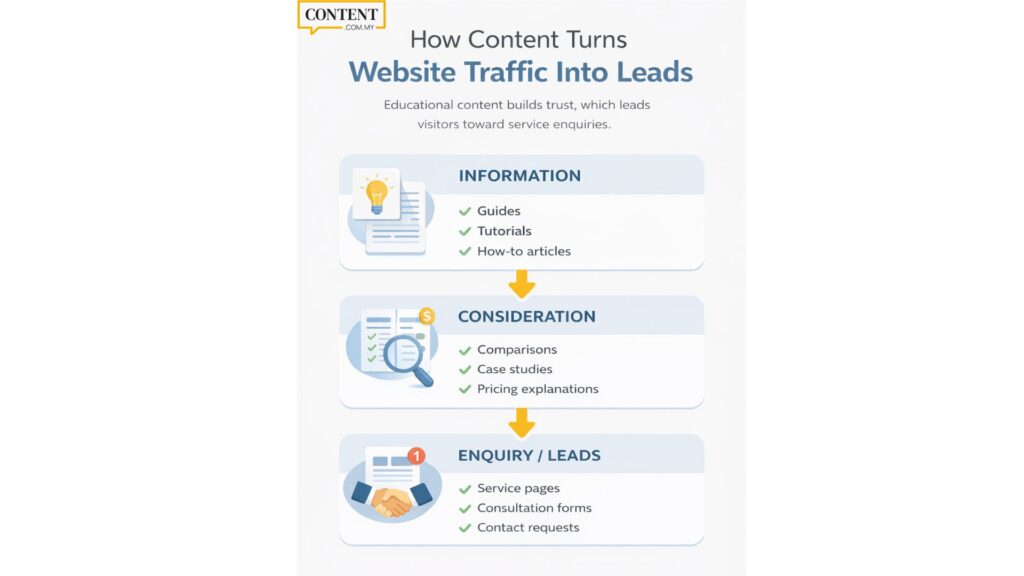
Over time, this content attracts visitors who are actively researching solutions and naturally moves visitors through different stages of decision making.
Stage | Type Of Content | Example |
Information | Educational articles | “How international shipping works” |
Consideration | Comparison or solution guides | “Freight forwarding vs courier shipping” |
Commercial | Service pages or consultations | “Freight forwarding services Malaysia” |
In other words, content helps guide visitors through a simple progression:
Information → Consideration → Enquiry
Conclusion: Get The Website Traffic Relevant to Your Site
Search engines today prioritize usefulness. Websites that consistently publish helpful, and well-crafted content tend to build authority over time, making it easier for both informational articles and service pages to rank.
At Content.com.my, we help businesses turn their websites into long-term traffic and lead generation channels.
Our content marketing services focus on identifying what your customers are searching for, creating high-quality articles that address those needs, and structuring content so it performs well in both traditional search and AI-driven results.
By combining
- SEO strategy
- Topic researcH
- professionally written content
We help websites attract the right visitors and guide them toward becoming enquiries and customers.
“Businsses want enquiries, leads and sales, we deliver all 3 of them with our services.”

Frequently Asked Questions About Why Websites Get No Traffic
How Long Does It Take To Fix Zero Traffic?
Technical fixes such as page speed improvements may show results within weeks. Content-driven SEO improvements usually take three to six months to produce consistent rankings.
Do I Need To Blog Every Day To Get Traffic?
No. A few comprehensive guides that solve problems are typically more effective than many short articles with limited depth.
Is Social Media Traffic Better Than SEO Traffic?
Social media generates awareness, but search traffic often converts better because users are actively looking for solutions.
Why Is My Website On Page One But Getting No Clicks?
Your meta title or description may not clearly communicate value. Search users often choose results that promise specific answers.
Does My Business Need A Bahasa Malaysia Version Of The Website?
If your audience includes the general Malaysian public, bilingual content can capture additional search traffic.
Is Google Still The Most Important Search Engine?
Yes, although websites should also structure content for AI-generated search summaries.