Key Takeaway
- AEO focuses on providing direct answers that AI engines can extract and summarise.
- Structured formats such as tables, lists, and schema markup improve AI visibility.
- Malaysian AEO content should reference local entities such as BNM, MCMC, and government sources.
- Question-based headings help content appear in AI summaries and voice search results.
- Clear, modular sections make it easier for AI engines like ChatGPT and Gemini to reference your content.
Table of Contents
Answer Engine Optimization (AEO) focuses on structuring content so AI models can quickly understand, summarise, and deliver information to users. By presenting clear answers, structured sections, and verifiable facts, AEO helps your content become the source AI engines reference when generating responses.
AI search is rapidly changing how people discover information online. Instead of scrolling through multiple websites, users increasingly receive instant answers generated by AI engines such as ChatGPT, Gemini, and Bing Copilot.
For Malaysian businesses, this shift means ranking on Google alone is no longer the end goal (though it definitely should still be!)
The real advantage now comes from becoming the source AI systems trust and cite when producing answers for users searching about regulations, services, or local expertise.
And our content marketing agency will teach you how.
What Is AEO (Answer Engine Optimization)?
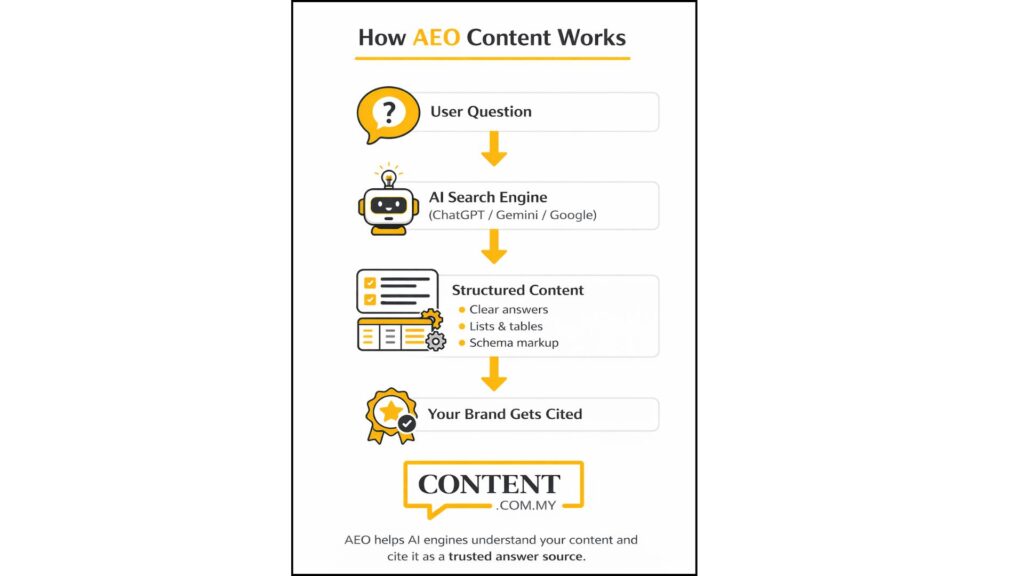
AEO is the practice of creating content so AI engines can extract and deliver clear answers to user queries.
Unlike traditional SEO, which focuses mainly on rankings and keywords, AEO prioritises clarity, structure, and verifiable information so AI systems can easily interpret the content.
Instead of relying primarily on keyword placement, AEO content focuses on:
- Clear answers
- Proper formatting
- Verifiable facts
- Question-based headings
Example
Traditional articles often begin with long introductions before explaining the main point.
AEO articles provide the answer immediately.
Example query: “What is a pillar page in SEO?”
An AEO-friendly response may look like:
- A pillar page is a comprehensive guide that covers a broad topic in depth
- It acts as the central hub linking to related cluster articles
- Each cluster article explores a specific subtopic in greater detail
- Internal links connect cluster pages back to the pillar page
- This structure helps search engines understand topic authority
This format allows AI systems to extract the definition quickly while also recognising the topic structure of the content.
How Is AEO Different from Traditional SEO?
Traditional SEO focuses on ranking in search results, while AEO focuses on becoming the answer AI engines display.
Both strategies overlap, but their content strategies and optimisation priorities differ, by quite a bit!
AEO vs Traditional SEO
Feature | Traditional SEO | AEO | Key Difference |
Primary Goal | Rank in search results | Become AI-generated answer | AI summaries prioritise clarity |
Content Style | Narrative articles | Structured answers | Easier AI extraction |
Trust Signals | Backlinks and authority | EEAT and factual references | AI models rely on verified data |
User Intent | Click-through traffic | Immediate answers | Supports zero-click search |
Content Format | Paragraphs | Lists, tables, schema | Improves AI parsing |
Search trends increasingly show a shift toward zero-click interactions, where users receive answers directly from search engines or AI assistants.
“Google Overviews is a clear example of that, how many times have you stopped scrolling down websites because the AI overview already gave you the answer you’re searching for?”
For businesses, this means being the cited source matters more than simply ranking first.
How Do AI Overviews Decide Which Websites to Cite?
AI engines favour sources that provide trustworthy and easily extractable information.
When generating responses, AI systems scan large volumes of content and prioritise pages that clearly present answers and demonstrate authority.
“Large language models generate responses by synthesizing information from patterns learned during training and retrieved context.” – OpenAI Research
Factors That Influence AI Citations
Factor | Why It Matters |
Clear Answer Blocks | Enables quick extraction of responses |
Structured Formatting | Lists and tables simplify summarisation |
Trustworthy sources are prioritised | |
Entity Recognition | References to recognised organisations strengthen credibility |
Consistent Topic Coverage | Builds subject authority |
Example
Consider two articles answering the same query.
Article A
- Long introduction
- No structured sections
- Minimal factual citations
Article B
- Question-based headings
- Direct answer summaries
- Tables and lists
- Authoritative references
AI engines are more likely to extract answers from Article B because the information is easier to interpret.
For Malaysian businesses, referencing recognised institutions such as:
- Bank Negara Malaysia
- Malaysian Communications and Multimedia Commission (MCMC)
- Government agencies
- Industry research reports
can strengthen credibility signals for AI systems.
Why Is Structured Content Important for AEO?
Structured formatting helps AI engines understand the hierarchy and meaning of your content.
You might have noticed the word “structured” being tossed in this article a lot.
That’s because LLMs (Large language models) identify patterns such as headings, lists, and tables to interpret web pages.
When information is organised clearly, AI systems can extract it more efficiently.
Important AEO formatting elements include:
- Question-based headings
- Direct answer summaries
- Bullet lists
- Comparison tables
- Definition boxes
Example
Instead of writing a long paragraph comparing products, a simple table improves readability and AI extraction.
Product | Feature | Best For |
Product A | Lower price | Budget users |
Product B | Advanced features | Professionals |
Tables like this are frequently used in AI summaries and featured snippets.
What Is the Ideal AEO Article?
An effective AEO article uses a modular format where each section answers a specific question independently.
Instead of long narrative explanations, AEO articles break information into standalone answer modules that AI engines can extract individually. In other words:
“Imagine the article as a series and each section as their own book with proper endings, that’s how you do it.”
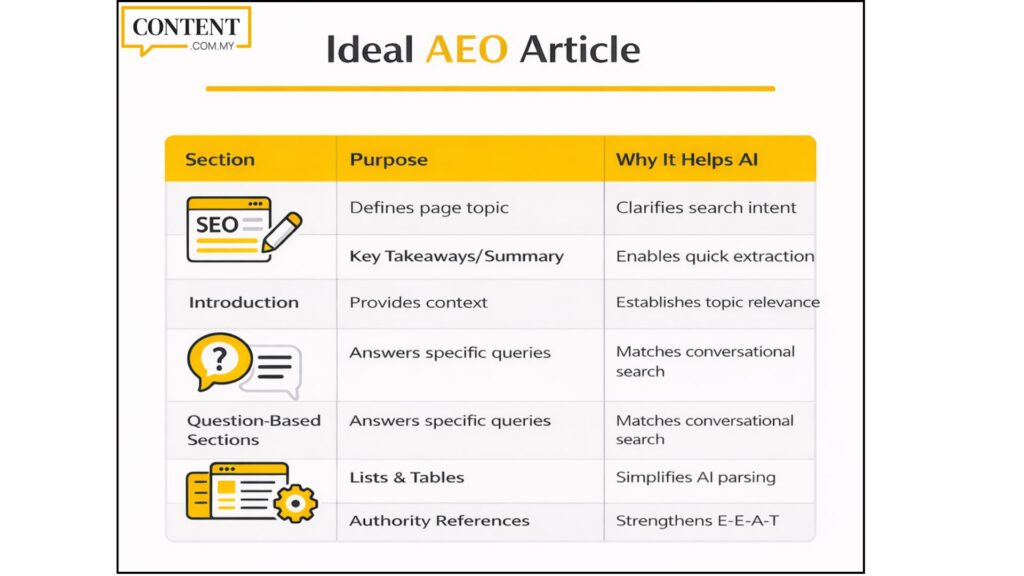
Ideal AEO Article
Section | Purpose | Why It Helps AI |
Meta Title & Description | Defines page topic | Clarifies search intent |
Key Takeaways/ Summary | Summarises main insights | Enables quick extraction |
Introduction | Provides context | Establishes topic relevance |
Question-Based Sections | Answers specific queries | Matches conversational search |
Lists & Tables | Organises information | Simplifies AI parsing |
Authority References | Adds credibility | Strengthens EEAT |
FAQ Section | Answers common queries | Improves snippet visibility |
Example Flow
A well-crafted AEO article typically follows this sequence:
- Key Takeaways
- Introduction
- What Is the Topic
- Why It Matters
- How It Works
- Examples or Comparisons
- Implementation Steps
- Conclusion
- FAQ Section
Each section acts as a mini answer unit that AI engines can reference independently. Want a good example? This very article you are reading right now has all of the elements!
What Is the SNIP Formula for Writing AEO Paragraphs?
The SNIP formula helps create paragraphs so AI engines can extract answers easily.
SNIP stands for:
Step | Meaning |
Statement | Begin with a clear answer |
Nuance | Add brief context |
Information | Provide explanation |
Proof | Support with data or authority |
Example Using SNIP
Statement: AEO content should be modular.
Nuance: Each section should answer one question independently.
Information: Clear summaries under headings improve AI extraction.
Proof: Creating content appears more frequently in AI summaries and featured snippets.
How Can Malaysian Businesses Localize AEO Content?
Localising AEO content means combining global writing with Malaysian search intent.
Malaysian users frequently search using local regulations, policies, or institutions. Including these references improves relevance and authority.
Examples include:
- EPF withdrawal rules
- SST registration requirements
- BNM interest rate updates
- PDPA compliance guidelines
- How to submit SST
- RapidKL LRT breakdown
Example
Instead of writing a general article about home loans, a Malaysian-focused version may include:
- LPPSA vs bank housing loans
- First-time home buyer schemes in Malaysia
- Stamp duty exemptions
- Rumah Selangorku
Localised content makes it easier for AI systems to associate the page with Malaysian policies and institutions.
Which Content Formats Perform Best for AEO?
Formats such as lists, tables, and checklists are easiest for AI engines to summarise.
Different formats work better depending on the type of information.
Content Format | AI Performance | Best Use Case |
Numbered Lists | High | Step-by-step guides |
Comparison Tables | Very High | Product comparisons |
Definition Boxes | Extremely High | Terminology explanations |
Checklists | High | Compliance tasks |
Tips
Choose the format based on the purpose of your content:
- Use lists for processes
- Use tables for comparisons
- Use definition blocks for concepts
This increases the likelihood of appearing in AI-generated answers.
How Do You Audit Existing Content for AEO Opportunities?
An AEO audit identifies pages that can be improved for AI extractability.
Many websites already contain useful information but lack the format AI systems need to recognise it as a direct answer.
Fortunately for you, there is no need for an overhaul.
AEO Audit Checklist
Element | What To Check | Example Fix |
Headings | Are they written as questions? | Change “PDPA Guide” → “What Are PDPA Requirements for Malaysian Businesses?” |
Answer Blocks | Does each section begin with a direct answer? | Add a 40 to 60 word summary |
Structure | Are lists or tables used? | Convert paragraphs into lists |
Local Entities | Are Malaysian institutions referenced? | Mention BNM, MCMC, EPF |
FAQs | Are common questions addressed? | Add concise FAQ responses |
Example
Traditional version:
“Malaysia’s PDPA regulates how businesses collect and store personal data.”
AEO-friendly version:
The Malaysian Personal Data Protection Act (PDPA) regulates how organisations collect, process, and store personal data. Businesses must obtain consent, protect stored data, and allow individuals to access their information.
The second version is easier for AI engines to extract and summarise.
Conclusion: Write for AI, Get Cited by Them
As AI search continues to grow across platforms such as ChatGPT, Gemini, and Bing Copilot, the brands that cater their content properly will gain a significant visibility advantage.
Appearing in AI summaries and citations increasingly depends on how clearly your information is written and supported by reliable sources.
At Content.com.my, our SEO copywriting services help businesses create structured, authoritative content designed for modern search environments.
By combining SEO strategy with AEO-ready formatting, our team helps brands produce content that AI engines can understand, extract, and reference, increasing the chances of appearing in AI-generated answers and citations.
“People are using AI to search and compare, you’re losing out if your brand is not mentioned in the conversation.”

Frequently Asked Questions About Writing AEO Content in Malaysia
What is the difference between SEO and AEO?
SEO focuses on improving rankings in search engine results pages, while AEO structures content so AI engines can extract and display direct answers to user queries.
How long should an AEO answer be?
AEO answers generally work best when they are around 40 to 60 words, which aligns with the typical snippet length used by search engines and AI summaries.
Does AEO work for Bahasa Malaysia content?
Yes. Modern AI models can interpret Bahasa Malaysia effectively. Clear writing and structured headings help AI systems summarise Malay content for local audiences.
Will AEO replace traditional blogging?
No. AEO changes how blogs are structured rather than replacing them. Articles should contain modular sections that provide standalone answers while still offering deeper explanations.
How do I use schema markup for AEO?
Use schema types such as FAQPage, HowTo, and Article to help search engines identify which sections of your page contain structured answers.
Should I stop using keywords for AEO?
Keywords still provide context, but AEO focuses more on entities, user intent, and structured answers rather than repeating keywords excessively.