
Key Takeaway
- Repeating a city name excessively reduces content quality signals in 2026
- Google understands highways, landmarks, transit lines, and commercial clusters
- Micro-neighbourhood targeting ranks you for broader city searches
- Schema markup allows invisible location optimization
- Landmark-rich pages are more likely to be cited by AI search engines
Table of Contents
Google’s AI-driven search ecosystem, including Search Generative Experience and Gemini integrations, evaluates contextual depth rather than keyword repetition. Location authority is no longer built through density. It is built through proximity intelligence.
If your website still says:
“Best contractor in Subang Jaya serving Subang Jaya residents in the Subang Jaya area…”
You are not optimizing, you are keyword spamming and frankly no one with a soul will read it.
Search engines now understand that mentioning:
- LDP
- SS15
- Sunway Pyramid
Already implies Subang Jaya.
For writers, business owners and marketers, this is the secret sauce to ranking locally for foot traffic and the best content marketing service in Malaysia will reach how to rank without repeating city names unnaturally.
Why City Name Repetition Is Now A Weak Signal
Search engines no longer rely on visible keyword density to determine local relevance.
Historically, repeating a city name improved rankings because algorithms relied heavily on on-page term frequency. That model is outdated.
Modern ranking systems use:
- Knowledge Graph entity mapping
- Geographic proximity modeling
- Structured data
- Local Business signals
- Behavioral engagement data
Google understands relationships between:
- Roads and cities
- Landmarks and districts
- Transit lines and neighbourhood clusters
This is part of semantic indexing evolution.
So when a page excessively repeats a city (or state) term, it may signal:
- Template duplication
- Low editorial quality
- AI-generated filler
- Thin location doorway pages
In competitive Malaysian markets such as Kuala Lumpur, this becomes a ranking liability.
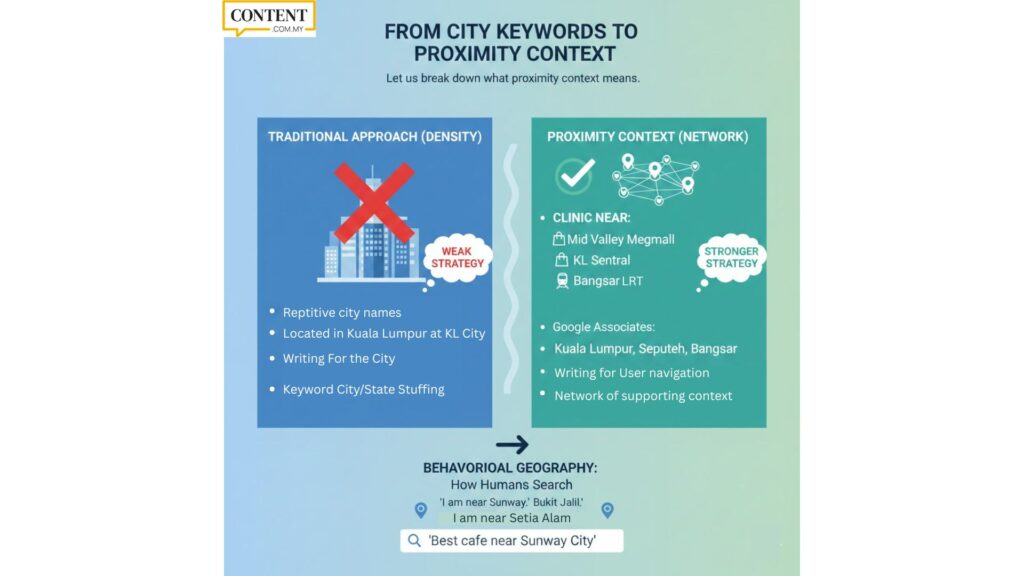
From City Keywords To Proximity Context
Let us break down what proximity context means.
If your clinic is near:
- Mid Valley Megamall
- KL Sentral
- Bangsar LRT
Google already associates your business with Kuala Lumpur, Seputeh, Bangsar. What this means is that you do not need to write “Kuala Lumpur” repeatedly in every paragraph.
Instead, you create a network of supporting contextual signals.
This is stronger than density.
So here’s the secret: Instead of writing for the city, write for how people navigate the city.
Local intent is rarely: “I am in Selangor municipality.”
It is usually:
“I am near Sunway.”
“I am around Bukit Jalil.”
“I am close to Setia Alam.”
That is behavioral geography, and it mirrors how real humans actually search such as “Best cafe near Sunway City”.
How to Write and Rank Locally
1. Transportation & Infrastructure Signals
Infrastructure is one of the strongest geographic indicators.
Malaysian users identify areas by:
- Highways
- Toll exits
- LRT or MRT stations
- KTM lines
- Major intersections
For example, instead of writing: “Top renovation service in Petaling Jaya”
Write: “Located along Jalan Universiti, accessible via the LDP and Federal Highway.”
Highways and transit markers provide:
- Clear geographic precision
- Strong Knowledge Graph mapping
- Real-world navigational context
They are more natural to users (more accurate) and stronger semantically.
2. Retail, Education & Social Anchors
Landmarks anchor local authority.
Search engines treat major malls, hospitals, schools, and business hubs as location entities.
Examples:
- 1 Utama (KL)
- Legoland Malaysia (JB)
- Queensbay Mall (Penang)
- A Famosa (Melaka)
- Concubine Lane (Ipoh)
This method increases:
- User recognition
- Trust perception
- AI contextual confidence
3. Micro-Neighbourhood Targeting (The Taman Strategy)
Malaysia’s addressing system is hyper-granular, SS2 is very different from SS3.
And this is an advantage.Instead of targeting:“Shah Alam”
Target:
- Seksyen 13
- Setia Alam
- Kota Kemuning
- Bukit Jelutong
Google aggregates micro-locations upward.
When you rank strongly for multiple neighbourhoods, you gain authority for the broader city term.
This reduces competition and increases topical authority density.
Element | Old City-Stuffing SEO | Cluster-Based SEO |
Headline | Best Clinic in Cheras | Family Clinic Near Leisure Mall |
Body | We serve Cheras and surrounding Cheras areas | Supporting households across Batu 9 and Taman Connaught |
Location Line | Located in Cheras, Selangor | Just off the Grand Saga Highway |
User Intent | Municipal identification | Recognizable landmark |
Cluster writing increases:
- Behavioral alignment
- Local engagement signals
- Dwell time
- Reduced bounce rates
These indirectly influence ranking strength.
The Technical Layer of Local SEO
You can rank for a city without aggressively repeating it in visible copy.
This may sound technical, but it is completely manageable for business owners, marketers, and copywriters.
The goal is separating:
- Human-readable content
- Machine-readable signals
When done correctly, search engines understand exactly where you operate, even if your city name appears only a few times on the page.
Read more: How to Write the Best Possible Content in Malaysia
areaServed Schema Markup
Structured data allows you to define your service area without overusing city names in your writing.
Using JSON-LD schema, you can define:
- areaServed
- GeoCoordinates
- AdministrativeArea
This tells search engines:
- The exact cities or regions you cover
- Your latitude and longitude
- The geographic relationship between your business and nearby areas
For example, a clinic physically located in Langkawi can:
- Set its exact coordinates
- Define Langkawi as its AdministrativeArea
- List Kuah and Pantai Chenang under areaServed
Even if your page headline says:
“Family Clinic Near Chenang”
Google still understands you operate within Kuah as well!.
NAP Consistency
Name, Address, Phone consistency across:
- Website footer
- Google Business Profile
- Business Directories
is still one of the strongest local ranking signals. In fact, we highly recommend business owners to optimize their GBP first.
Let your NAP carry authority instead of forcing city repetition into body copy.
Geo-Contextual Media
Upload images that include:
- Street signage
- Storefront visibility
- Nearby skyline
Alt-text example:
Weak: “Plumbing Kuala Lumpur”
Strong: “Emergency pipe repair with KL skyline visible from Ampang corridor.”
Search engines extract contextual clues from descriptive media.
Before publishing, audit your page using the framework below. Treat this as your final quality control layer before hitting “Publish.”
Local SEO Checklist
Checkpoint | What To Audit | Why It Matters In 2026 |
The 3-Mention Rule | Does the primary city name appear more than 3 times in the first 500 words? | Prevents city stuffing signals and improves natural readability. |
Infrastructure Reference | Have you mentioned at least one highway, toll exit, LRT, MRT, or KTM station? | Transportation signals strengthen geographic entity mapping. |
Landmark Anchor | Have you referenced a recognizable mall, hospital, school, or business hub? | Landmarks act as semantic anchors for AI and proximity modeling. |
Micro-Neighbourhood Mention | Have you included specific taman, seksyen, bandar, or corridor names? | Micro-locations help rank for broader city queries through cluster aggregation. |
Schema Validation | Is areaServed, GeoCoordinates, and AdministrativeArea correctly implemented? | Structured data confirms location precision without visible repetition. |
NAP Accuracy | Is your Name, Address, and Phone consistent across website and directories? | Citation consistency remains one of the strongest local trust signals. |
Common Mistakes Malaysian Businesses Still Make
Despite algorithm evolution, many local businesses are still applying tactics that worked a decade ago.
These approaches may not trigger penalties immediately, but they dilute authority and limit ranking potential in competitive markets.
Creating Separate Pages For Every Suburb With Identical Content
Many businesses generate:
- /plumber-subang-jaya
- /plumber-shah-alam
- /plumber-puchong
The only difference is the city name.
Everything else, including paragraphs, testimonials, and structure, remains the same.
This creates:
- Thin doorway pages
- Duplicate content clusters
- Authority fragmentation
Instead of building one strong, context-rich page, you split relevance across multiple weak URLs.
Google understands service radius and entity relationships. It does not require a cloned page per suburb to validate coverage.
Replacing Only The City Name Across Multiple URLs
This is a variation of the doorway strategy.
Example: “Best accounting firm in Kuala Lumpur” becomes “Best accounting firm in Johor Bahru”
Nothing else changes.
No landmark references, no infrastructure signals or local case examples.
Search engines detect templated structures easily. AI models are particularly good at identifying repetitive patterns.
Real local authority requires localized context, not find-and-replace editing.
Ignoring Micro-Neighbourhood Clusters
Malaysia’s geography is layered:
- City
- District
- Taman
- Seksyen
- Corridor
Micro-neighbourhood targeting builds upward authority. When you dominate clusters, broader city terms follow naturally.
Ignoring this structure means competing unnecessarily for high-difficulty head terms without building foundational local signals.
Overusing Exact-Match City Phrases In Headings
Headings such as:
- Best Lawyer In Petaling Jaya
- Affordable Dentist In Petaling Jaya
- Top Clinic In Petaling Jaya
Show repetition without contextual expansion.
Modern local SEO rewards:
- Landmark-based modifiers
- Infrastructure-based proximity
- Cluster-based positioning
Writing for Local With Contextualization
When your content reflects how real people navigate their surroundings, it becomes more authoritative and more citation-worthy.
If your page sounds like it was written by someone who actually understands the neighbourhood, search engines will understand it too.
And when it makes sense to search engines, it ranks.
At Content.com.my, we write with local intelligence.
We do not rely on templated suburb swaps or keyword stuffing. We build location-aware content that references:
- Infrastructure
- Landmarks
- Neighbourhood clusters
Our Local SEO copywriting services understand how Malaysians search, how they describe places, and how AI systems interpret proximity.
If you want pages that attract nearby customers instead of just impressions, we can help you structure, write, and optimize them properly.
Let us turn your website into a local authority that earns trust and traffic where it matters most.

Frequently Asked Questions About Local SEO Writing
What Is City Stuffing In Local SEO?
City stuffing is the excessive repetition of a location name to manipulate rankings. In 2026, search engines detect this pattern easily. It reduces content quality signals and may weaken trust instead of improving visibility.
Why Does Repeating A City Name Hurt Rankings Now?
Modern search systems rely on entity relationships and proximity signals, not keyword density. Repeating a city without adding contextual value signals templated or low-depth content, which can reduce authority and AI citation likelihood.
How Can I Rank Locally Without Repeating My City Name?
Use infrastructure references, landmarks, micro-neighbourhood names, and structured data like areaServed schema. These signals provide geographic clarity without sacrificing readability or overusing exact-match city phrases.
Do I Still Need Separate Pages For Every Suburb?
Not always. If the content is identical except for the suburb name, it may dilute authority. Instead, create strong cluster-based pages with meaningful localized context rather than duplicating templates.
Are Landmarks Stronger Than City Names For Local SEO?
Often yes. Recognizable malls, highways, transit stations, and neighbourhood clusters provide clearer proximity signals.
How Important Is Structured Data For Local Rankings?
Structured data helps search engines understand your service area, coordinates, and business entity relationships. It strengthens local clarity without requiring visible keyword repetition and improves eligibility for rich results.