
Key Takeaway
- A strong company branding strategy in Malaysia starts with clear positioning, not visuals or campaigns
- Effective branding balances local nuance, multilingual clarity, and internal consistency
- Strategy must guide decisions across marketing, sales, hiring, and partnerships
- Governance, rollout, and measurement matter as much as brand identity
- The strongest brands treat branding as a long-term operating system, not a one-off project
Table of Contents
A strong company branding strategy in Malaysia is built by aligning positioning, messaging, identity, and execution with how decisions are made, communicated, and evaluated locally. It must work internally before it works externally.
Many companies invest in logos, campaigns, or websites, yet struggle with unclear messaging or weak brand recall. The issue is rarely creativity, it is almost always a strategy.
Today, we will explain how to build an awesome branding strategy for teams and businesses of all sizes.
What Does a “Branding Strategy” Actually Mean?
A strong branding strategy defines how your company is understood, trusted, and chosen.
When we mention branding strategy, it goes beyond the colour of the brand or the font size of the letters.
Rather, it is how your business presents itself in words, actions, and decisions. A branding strategy answers four questions clearly:
- Who are we for, and who are we not for?
- What problem do we solve better than alternatives?
- How should we sound and behave across channels?
- How do we keep the brand consistent as the company grows?
In Malaysia specifically, brands must remain clear across English and Bahasa Malaysia, and handle multicultural audiences with care.
After all, poorly translated words can be detrimental than inspiring.
Let’s give an example:
Aiman, a young graduate, wants to open an ice cream shop in Johor Bahru.
- Positioning Decision: Instead of starting with a catchy name, he defines what the shop stands for first.
- Core Focus: Small-batch ice cream made with local flavours (teh, milo and 3 layer tea), priced for families and weekend visitors at a mall kiosk.
- Brand Execution: He chooses a name that reflects this focus, uses clear signage in both English and Bahasa Malaysia, such as “The Lokal Churn”.
- Consistency: Menu descriptions stay simple and consistent across the shop, delivery platforms, and social media, all mentioning “kopitiam flavour and authentically local”.
- Result: Customers quickly understand what the shop represents and remember it for a specific reason, not just a confident-sounding name
How Businesses Should Define Brand Positioning Before Anything Else?
Positioning is the foundation of any brand without it, branding quickly becomes subjective.
A usable positioning statement should make a few things immediately clear:
- Who the brand is meant for, and in what context
- The core problem or job it helps solve
- The main value or outcome customers should expect
- What truly sets it apart from alternatives
- The competitive frame it wants to be compared within
A simple positioning formula often helps keep this practical:
“For companies that [context], we are the [category] that [primary value], unlike [alternative], because [reason to believe].”
Positioning also needs to reflect how buying decisions actually happen:
- Price sensitivity, without defaulting to “affordable” as the only message
- Clear trust signals for first-time buyers
- The difference between decision-makers and end-users
- Expectations around credibility, experience, and track record
When positioning is done well, it acts as a shared decision filter.
Fun fact: According to Forbes, most companies allocate about 5 % to 10 % of their annual marketing budget to rebranding efforts, and broader branding efforts can take up to 20 % of the overall marketing budget in some organisations.
How Should Brand Messaging Be Done?
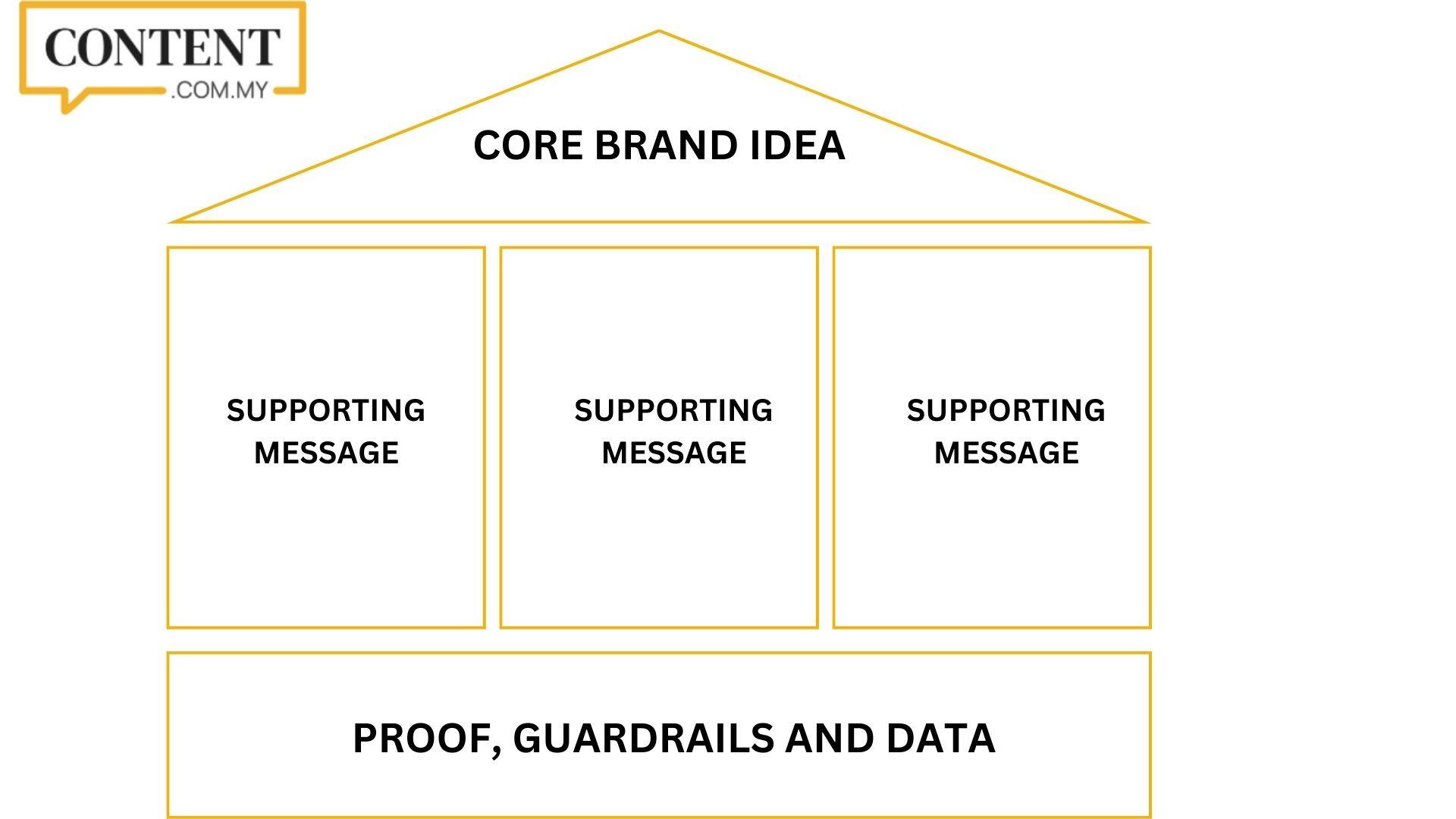
One of the most effective ways to structure brand messaging is by using a message house.
Put simply, a message house is a framework that keeps communication clear, consistent, and easy for teams to use.
A typical message house includes:
- One core brand idea
- Three supporting message pillars
- Clear proof points for each pillar
- Guardrails that define what can be said, and how it should sound
It sounds simple because it is. The strength of a message house lies in its simplicity.
When everyone works from the same agreed framework, messaging stops being open to interpretation.
This structure helps different teams explain the brand consistently across:
- Websites and proposals
- Sales conversations
- Social content and advertising
- Recruitment and employer branding
Example: A SaaS company selling workflow software uses one core idea around reducing manual work. Its message pillars focus on:
- Time savings
- Reliability
- Ease of adoption
Sales teams, marketers, and recruiters all speak from the same set of messages, even though the context and wording differ.
What Role Does Visual Identity Play in Branding?
Visual identity supports strategy, it does not replace it.
Over the years, you might have noticed brands and logos becoming more… simpler. Mr potato for example has a cleaner and less detailed face, while other brands are going for minimalism.
The truth: A simpler system is easier to recognise and easier to apply correctly.
That is why a strong visual system usually includes:
- Clear logo usage rules
- Defined colour and typography hierarchy
- Consistent layout principles
- A unified image or illustration style
The goal is not uniqueness for its own sake, but recognisability and consistency. Visual identity should make the brand easy to identify and difficult to misrepresent.
“Google is well known for its “41 shades of blue” experiment. The company tested dozens of slightly different blue tones for its advertising links through large-scale A/B testing. The winning shade reportedly increased click-through rates enough to generate an estimated USD 200 million in additional annual revenue.”
How Do You Roll Out Branding Internally Without Losing Control?
One part that is often overlooked during rebranding is how the internal team feels about the change.
Stakeholders and customers matter, of course, but the people running the day-to-day operations are the ones who actually keep the brand alive.
If the internal team does not understand or believe in the brand, consistency breaks down quickly, no matter how strong the strategy looks on paper.
An internal rollout plan usually includes:
- Clear ownership, often a single brand lead
- Simple brand guidelines that explain intent, not long design manuals
- Training for sales, marketing, and leadership teams
- Approved templates for common, everyday use cases
Scenario: If sales teams start rewriting messaging because it feels “too marketing-heavy,” the issue is that the strategy has not been translated into language they can confidently use.
That gap is best fixed early, before habits form.
When Should a Company Revisit or Rebuild Its Branding Strategy?
If you are reading this, you are probably in one of two camps.
- You want to build a strong branding strategy so you do not have to rebrand every few years.
- You know a rebrand is needed, but are unsure where to start or what to fix.
In practice, branding should be revisited when the business changes in any meaningful way.
That change might be visible externally, or it might be happening quietly inside the organisation.
Common triggers include:
- A shift in target market or product direction
- Rapid growth, restructuring, or new leadership
- Mergers or acquisitions that bring different identities together
- Declining differentiation, even with continued marketing spend
- Expanding into new markets
It is also worth noting that refreshing branding does not always mean rebranding. Often, the work is about clarifying strategy, tightening your messaging, and bringing execution back into how the business actually operates.
Building a Strong Company Branding Strategy in Malaysia
A strong company branding strategy is not about chasing trends or refreshing visuals every few years.
It is about creating clarity that guides decisions, aligns teams, and builds trust over time.
That is how branding supports growth, consistency, and credibility, especially as companies expand, hire, or enter new markets.
If you are looking for a branding strategy that goes beyond logos and slogans, our content marketing agency is designed to do exactly that. We help businesses clarify their positioning, structure their messaging, and translate strategy into content that teams can actually use.
If you are ready to build a brand that communicates clearly and grows with your business, this is where the work should start.


Frequently Asked Questions About Branding Strategy in Malaysia
What Is The Difference Between Branding And Brand Strategy?
Brand strategy defines direction and rules. Branding is the execution of that strategy through visuals, messaging, and experiences.
Do Small Companies Need A Formal Branding Strategy?
Yes. Smaller teams benefit even more from clarity, because inconsistency and confusion are costlier at a limited scale.
Is Branding Only Relevant For Consumer-Facing Companies?
No. B2B companies rely heavily on branding for credibility, trust, and differentiation during longer decision cycles.
How Long Does It Take To Build A Strong Branding Strategy?
A solid strategy can be developed in weeks, but adoption and consistency take months of disciplined execution.
Should Branding Be Handled Internally Or With External Specialists?
Either can work. What matters is clear ownership, experience, and accountability for long-term consistency.
Does Branding Need To Change Every Few Years?
Not necessarily. Strong brands evolve gradually. Frequent overhauls often signal weak foundational strategy.